OEC Pick 5
Guess a country's top five export products.
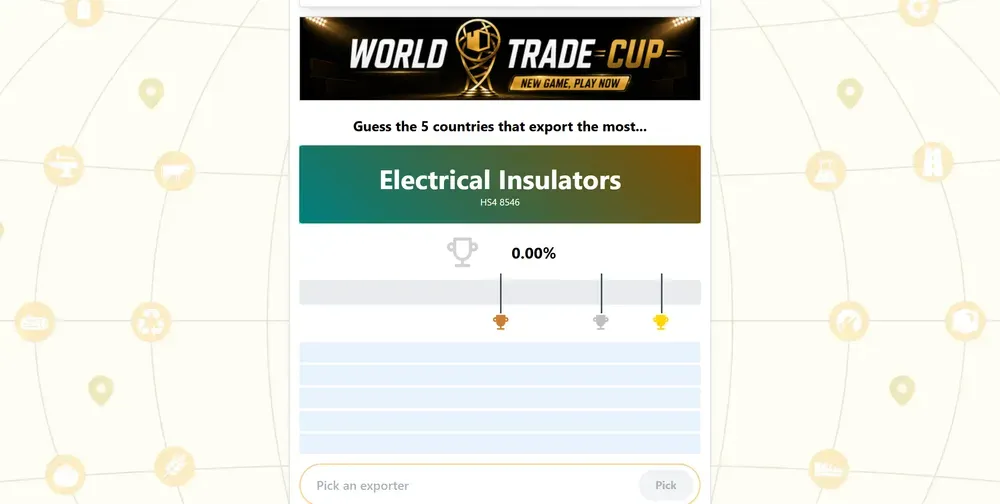
OEC Pick 5 hands you a real traded product, something like beer, coffee, cars, or insulated wire, and asks you to name the five countries that export the most of it. Every guess gets checked against actual global trade figures from the Observatory of Economic Complexity, so you are reasoning about real supply chains, not folklore about which country makes what. It is a short daily habit built for people who like geography and data more than wordplay.
What is OEC Pick 5?
OEC Pick 5 is a daily browser game published by OEC Games, the games arm of the Observatory of Economic Complexity (oec.world). Each day the game selects one product classified at the Harmonized System 4 digit level, the same classification customs authorities use to categorize goods in international trade, and challenges you to identify its top 5 exporting countries. You type in country names one at a time and submit them, and correct answers fill the five slots. There is no letter grid or silhouette to decode, just your knowledge of who actually ships what around the world.
Unlike most geography dles, Pick 5 is built entirely on real trade statistics rather than trivia written by a puzzle editor. The product changes every day, so one morning you might be reasoning about wine exporters and the next about semiconductors or furniture. It sits alongside sibling games in the OEC Games portfolio, including Tradle, which has players guess a mystery country from its export data in up to six tries, and Export Hold'em, a real time multiplayer trade game. Pick 5 is the one built specifically around ranking, naming the actual top exporters rather than identifying a single mystery country.
The Observatory of Economic Complexity itself traces back to 2012, when it began as MIT researcher Alex Simoes's master's thesis under economist Cesar A. Hidalgo, before growing into the open trade data platform it is today. The current version of oec.world, including its games hub, is designed and developed by Datawheel. Pick 5 launched in 2024; OEC introduced it as a new daily game in social media posts that May.
After each guess, Pick 5 tells you the country's actual export value for that product and its global rank, so a wrong guess still teaches you something useful for the next attempt. Once you finish, the game scores your round as a percentage and awards a bronze, silver, or gold cup depending on whether the countries you picked account for more than 50, 75, or 90 percent of the product's world exports. You can register a free account to keep personal stats and appear on a global leaderboard, but nothing is required to just play. The whole loop is quick, reportedly playable in under two minutes, which makes it an easy one to slot into a coffee break.
How to play OEC Pick 5
- Open OEC Pick 5 at oec.world (oec.world/en/games/pick-5).
- Read the product shown for the day, such as a specific food, material, or manufactured good.
- Type a country name you think ranks among that product's top 5 exporters and submit your guess.
- Check the feedback shown for that country, its export value and global rank for the product, to inform your next guess.
- Continue naming countries, aiming to identify all 5 top exporters and cover as much of the product's world exports as you can.
- Optionally create a free account to track your stats and see how you compare on the leaderboard.
Tips and strategy
- Think about production capacity and geography first, since major exporters of raw or bulk goods are often large, resource rich countries rather than the countries that consume the most.
- Remember that exporting a lot of a product is different from being famous for it. Some of the biggest exporters by value are re export or manufacturing hubs, not the country most associated with the product culturally.
- Use the rank and value feedback after a wrong guess to recalibrate. If a guess ranks far outside the top 5, that tells you the real leaders are a different tier of economy entirely.
- Consider the product's category. Manufactured and electronic goods tend to cluster around a different set of exporting countries than raw agricultural or mineral products.
- Do not assume the largest overall economies dominate every category. Smaller countries can lead in specific product exports because of climate, natural resources, or specialized industry.
- Play daily rather than trying to cram, since the product changes every day and each one teaches you about a different slice of global trade.
Good to know
- Category
- Geography and trade data
- Resets
- Daily, with a new product each day
- Cost
- Free to play, with an optional free account for stats and leaderboard
- Guesses
- No guess cap has been publicly documented; you submit country names one at a time, aiming to identify all 5 top exporters
- Modes
- Single daily challenge
- Feedback
- Shows each guessed country's export value and global rank; a bronze, silver, or gold cup rewards picks covering more than 50, 75, or 90 percent of world exports
- Creator
- OEC Games, published by the Observatory of Economic Complexity, developed by Datawheel
- Launched
- 2024
OEC Pick 5 FAQ
Is OEC Pick 5 free to play?
Yes. Anyone can play without an account. Creating a free account is optional and just adds personal stats tracking and a spot on the global leaderboard.
How do you play OEC Pick 5?
Each day you get a real traded product. You type in country names one at a time, trying to identify the five countries that actually export the most of that product, and each guess shows you the country's export value and rank so you can adjust your next try.
When does OEC Pick 5 reset?
A new product is featured every day. It is not currently confirmed whether OEC keeps an archive of previous days' products to play retroactively.
Is OEC Pick 5 like Wordle?
It shares Wordle's daily, one puzzle per day format, but the guessing itself is different. Instead of guessing letters in a word, you guess countries against real global trade export rankings for a product.
Who made OEC Pick 5?
It is published under OEC Games by the Observatory of Economic Complexity, a trade data platform that originated as an MIT master's thesis in 2012 and is currently designed and developed by Datawheel.