Globeiku
Guess the country from real-world stats.
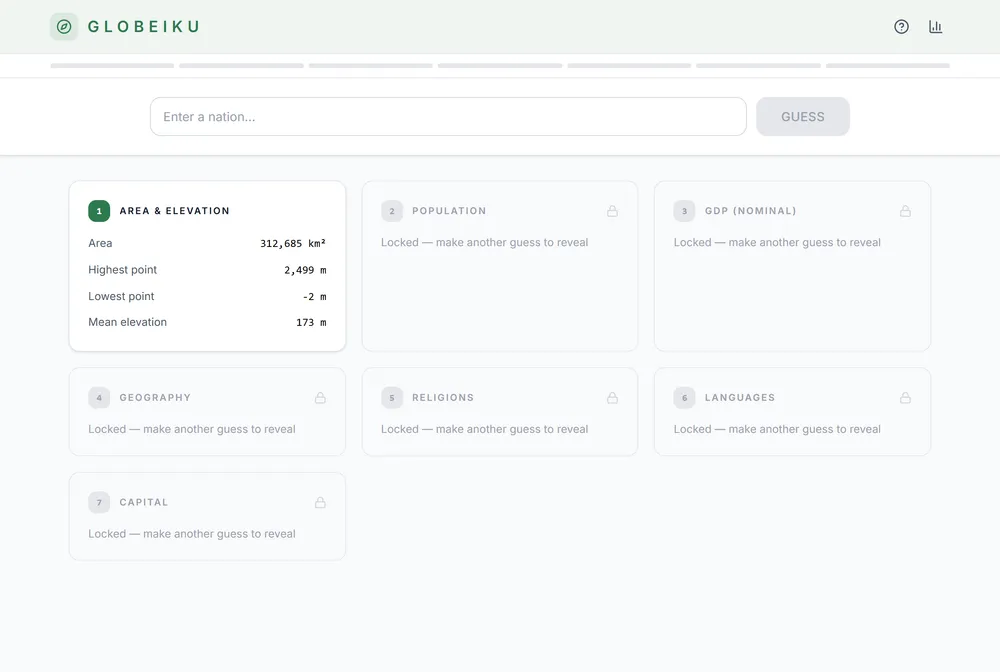
Globeiku is a free daily country-guessing game where you identify one hidden nation from its real-world statistics, such as population, GDP, and languages spoken, rather than from a map outline or letters. It follows the Worldle-style once-a-day format: everyone gets the same mystery country, and for each wrong guess Globeiku uncovers a new fact about that country to help you deduce the answer.
What is Globeiku?
Globeiku belongs to the daily country-guessing family that Worldle and Globle popularized, but instead of a map or a flag silhouette, it hands you a country's raw statistics and asks you to recognize the place behind the numbers. Every player gets the same hidden country each day, and your job is to name it through deduction, reading clues like population, GDP, and the languages spoken there rather than spelling out a word or reading a map.
The core loop is built around a progressive reveal. You guess a country, and if you are wrong, Globeiku uncovers a new fact about the mystery nation to push you closer to the answer. The official description puts it plainly: for each wrong guess you uncover a new fact to help you solve the puzzle before it is too late. So the first guess is the hardest, made on limited information, and every miss trades a turn for an extra data point. As the stats stack up, the field of plausible countries narrows: a population figure rules out the very large or very small, a GDP reading separates wealthy economies from developing ones, and a list of spoken languages can point straight at a region or a former colonial sphere.
That stats-deduction angle is what sets Globeiku apart from its map-based cousins. In Globle you reason about where countries physically sit, and in Worldle you read an outline. Globeiku instead rewards knowing what countries are like: how many people live there, how big the economy is, and what tongues are spoken day to day. It turns each puzzle into a small exercise in matching a national profile to a name, which is a different muscle than spatial recall, and it tends to teach you something concrete about a country even on the days you solve it quickly.
The game is free to play in the browser and is built to work well on a phone in vertical orientation, so it fits a quick daily session on mobile as easily as on a desktop. It is inspired by Worldle and shares that once-a-day, everyone-gets-the-same-puzzle rhythm, which makes it easy to compare how you did against friends who played the same country. Creator and publisher details for Globeiku are not publicly documented, so this page describes the game from its stated mechanic and live behavior rather than naming a maker, and a few finer points such as any exact guess cap are not confirmed from public sources.
How to play Globeiku
- Open the daily puzzle, which presents the same mystery country to every player for that day.
- Make your first guess by naming a country, using the limited information available at the start.
- If your guess is wrong, read the new fact Globeiku reveals about the hidden country, such as a population, GDP, or language clue.
- Combine each revealed statistic to narrow the field, ruling out countries whose profile does not match the clues so far.
- Keep guessing, picking up one more fact with every miss, until you name the correct country.
- Return the next day for a new country, since the puzzle resets daily and is the same for everyone.
Tips and strategy
- Lead with the strongest clue you have: a population or GDP figure usually eliminates more candidates faster than a single language does.
- Use language clues to lock in a region, since a widely spoken language can point to a continent or a former colonial sphere in one read.
- Treat population as a bracket rather than an exact match, grouping countries into rough tiers so you can rule out the far-too-large and far-too-small at a glance.
- Cross-reference GDP with population, because a high total economy with a small population suggests a wealthy nation, while a large population with modest GDP suggests a developing one.
- Spend an early guess on a country whose stats you know well, so that being wrong still reveals a useful contrast against the next fact.
- Since every miss hands you another clue, do not be afraid to make an informed guess once you have narrowed the options, rather than stalling on perfect certainty.
Good to know
- Category
- Geography, daily country guessing
- Cost
- Free to play in the browser
- Schedule
- New mystery country each day
- Core mechanic
- Guess a country from real-world stats like population, GDP, and languages
- Feedback
- Each wrong guess reveals a new fact about the hidden country
- Style
- Worldle-inspired, mobile-friendly vertical layout
Globeiku FAQ
Is Globeiku free?
Yes. Globeiku is a free daily geography game you play in your browser at globeiku.com, with no purchase required to play the daily puzzle.
Is Globeiku related to Wordle?
It shares Wordle's once-a-day format, where everyone gets the same puzzle and the answer resets daily, but it is a geography game rather than a word game. It is described as Worldle-inspired, since you identify a country from clues instead of guessing letters.
How do the clues work in Globeiku?
You guess a country, and for each wrong guess Globeiku uncovers a new fact about the hidden country, such as its population, GDP, or the languages spoken there. You use these revealed statistics to deduce and name the correct country.
How is Globeiku different from Globle or Worldle?
Globle and Worldle rely on map position or a country outline, while Globeiku is stat-based: you recognize the country from its real-world statistics rather than from its shape or location. That makes it a deduction game about national profiles instead of a spatial or visual one.
Who made Globeiku?
Creator and publisher details for Globeiku are not publicly documented. This page describes the game from its stated mechanic and live behavior rather than naming a specific maker.