Worldle
Identify the country from its outline.
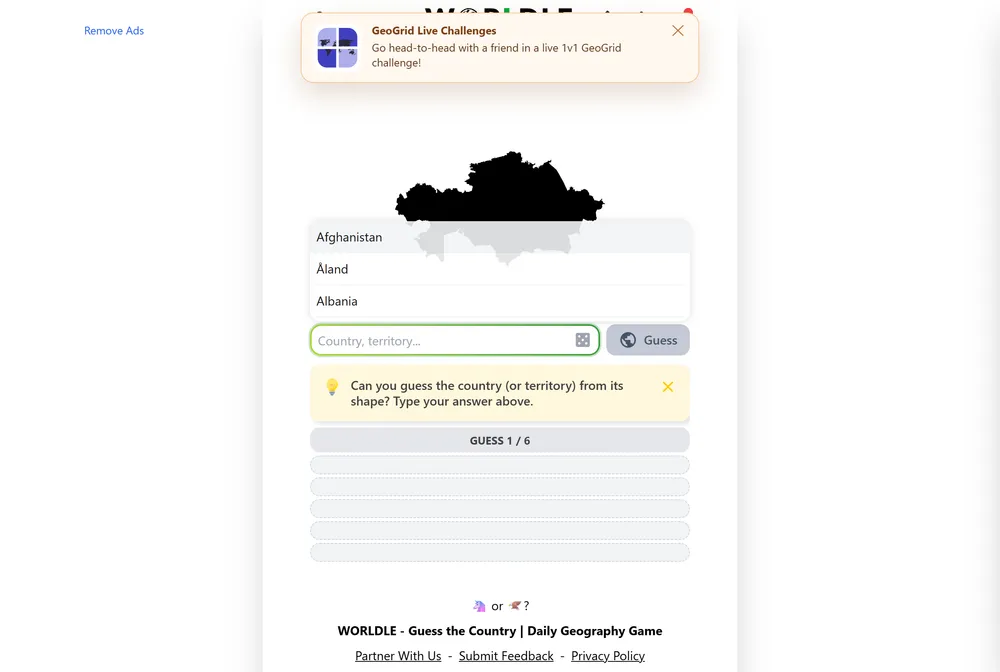
Worldle hands you the bare silhouette of a country or territory and asks you to name it in six tries. Every wrong guess feeds back the distance to the target, a compass arrow pointing toward it, and a proximity percentage, turning each attempt into a geographic triangulation. It is a daily one-shape puzzle that rewards knowing not just country borders but where places sit on the globe.
What is Worldle?
Worldle is a daily geography game built around a single shape. Each day it displays the outline of one country or territory, stripped of any labels, color, or surrounding map, and your job is to identify it within six guesses. When you submit a country that is not the answer, Worldle reports three things at once: how far that country sits from the target in kilometers or miles, an arrow pointing from your guess toward the answer, and a proximity percentage where 100 percent means you found it. This combination is what separates Worldle from plain word games. You are not matching letters, you are reasoning about real-world position, drifting your next guess in the arrow's direction and closing the distance gap with each attempt.
What makes Worldle distinct among the wave of Wordle spin-offs is that its difficulty comes from spatial reasoning rather than vocabulary. The silhouette alone can be a giveaway for an unmistakable shape like Italy or Chile, or nearly impossible for small island nations and territories that look like specks. Because the feedback is geographic, a single smart guess in the right region can collapse the search quickly: the distance and arrow together often pin the answer to a narrow band of the map. Many versions of the puzzle also include optional bonus rounds after you solve the country, such as guessing its flag, naming bordering countries, or answering general facts, which deepen the round for players who want more than the one shape.
The game was created in early 2022 by Antoine Teuf, a French web and video game developer based in Montpellier who goes by teuteuf. He built it as a side project and a tribute to Wordle rather than a clone, leaning entirely into geography instead of letters. Worldle caught on almost immediately, approaching a million players within days of launch and earning coverage in outlets like The Washington Post. It has since grown into the anchor of a wider catalog of teuteuf geography and trivia games.
When you finish, Worldle generates a shareable result grid that encodes how close each guess was using colored squares: green for a guess very near or on the target, yellow for one in the middle range, and a dark square for guesses that landed far away, with the proximity rounded down to the nearest ten so you can compare runs with friends without spoiling the answer. The overall vibe is calm and educational rather than competitive: it is quick to play, satisfying to solve, and genuinely teaches you the map over time. It suits geography buffs, travelers, classroom use, and anyone who wants a short daily brain exercise with real-world payoff.
How to play Worldle
- Open Worldle to see the day's mystery country or territory shown only as a plain silhouette.
- Type a country or territory name as your first guess and submit it.
- Read the three feedback signals: the distance to the target, the arrow pointing toward it, and the proximity percentage.
- Use the arrow and distance to choose a next guess that moves toward the answer and shrinks the remaining gap.
- Keep guessing, narrowing the region each round, until you reach 100 percent or use all six attempts.
- Solve any optional bonus rounds if offered, then share your result grid of green, yellow, and dark squares.
Tips and strategy
- Open with a guess in the rough hemisphere you suspect, then let the arrow and distance redirect you instead of guessing randomly.
- Treat the distance number as your primary tool: halving the remaining kilometers each guess narrows the answer far faster than chasing the arrow alone.
- Remember the arrow uses only eight directions, so near the target it can be slightly off; trust distance over direction once you are close.
- Learn the unmistakable silhouettes (Italy, Chile, Japan, the United Kingdom) so you can solve those days in one guess and save attempts for hard ones.
- When the shape is a tiny island or speck, expect a territory or microstate and guess a known one in that ocean to get a distance bearing.
- Use a guess on a large, centrally located country early to get a strong distance reading that splits the map cleanly.
Good to know
- Resets
- Daily at midnight in your device's local time zone
- Guesses
- 6 attempts per puzzle
- Cost
- Free to play in a web browser
- Archive
- Past puzzles available, but archive mode requires Premium
- Creator
- Antoine Teuf (teuteuf), a French developer based in Montpellier
- Launched
- Early 2022
Worldle FAQ
Is Worldle free?
Yes, Worldle is free to play in your web browser. The daily puzzle costs nothing; only extras like the puzzle archive require a paid Premium membership.
How many guesses do you get in Worldle?
You get six guesses to identify the country or territory. Each wrong guess returns the distance, a direction arrow, and a proximity percentage to guide your next attempt.
When does Worldle reset?
A new Worldle puzzle appears every day at midnight in your device's local time zone, so the timing follows your own clock rather than a fixed global hour.
Is there a Worldle archive?
Yes, past Worldle puzzles can be played through an archive mode, but accessing it requires signing up for the paid Premium membership.
What do the colors in the Worldle share grid mean?
The shareable grid uses colored squares to show how close each guess was: green marks a guess very near or on the target, yellow marks a mid-range guess, and a dark square marks a guess that landed far away. The proximity is rounded down to the nearest ten so the grid never reveals the answer.
Is Worldle related to Wordle?
Worldle was inspired by Wordle and shares the six-guess daily format and shareable square grid, but it is a separate geography game. Its creator describes it as a tribute to Wordle, not a copy.