Weatherdle
Identify the city from seven days of its weather.
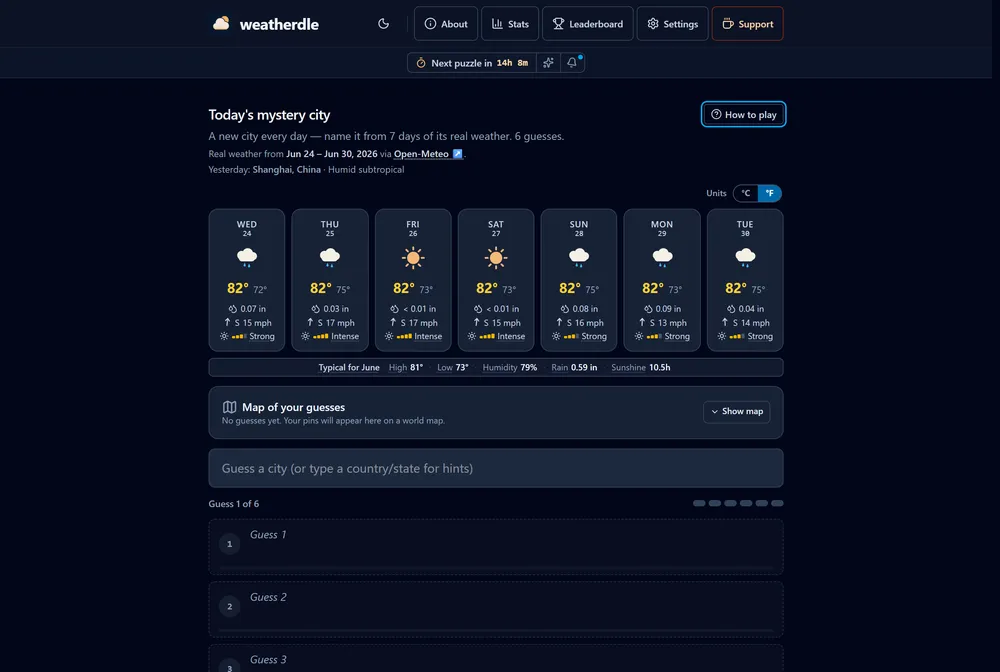
Weatherdle hides a mystery city behind seven days of its real weather. There is no outline, no flag, and no photo, just the numbers. You get six guesses, and each one tells you how far off you are, which direction to look, and whether your guess even sits in the right climate.
What is Weatherdle?
Weatherdle is a daily guessing game built around a single clue: a strip of seven days of real, recent weather for one hidden city, showing daily high and low temperatures, precipitation, wind, and a condition icon for each day. Everyone who plays that day sees the same city and the same weather, and a new puzzle goes up at 00:00 UTC. According to the site's about page, the weather is pulled fresh each day from Open-Meteo's free Historical Weather API, and each puzzle's source week is shown in the header so you can check it yourself.
The solving loop works by triangulation rather than recognition. You type a city name, and the game reports the distance from your guess to the answer in kilometers or miles, a sixteen-point compass arrow pointing toward the real city, and a climate hint that says whether your guess shares the mystery city's Köppen climate group, its exact climate subtype, or neither, along with hemisphere and continent matching. The Köppen classifications come from the dataset published by Vienna University of Technology. This makes Weatherdle feel closer to Worldle than to Wordle: in Worldle you narrow down a country by its shape, while here you read a week of temperature swings, rain, and wind and ask what kind of place produces that pattern, coastal or continental, tropical or temperate, northern or southern hemisphere.
You get six guesses per day, and landing within roughly 16 miles of the target, an adjacent city for example, counts as a solve. Solving each day grows your streak. The site's copy describes two mercy rules: a near miss within about 50 km still counts as a loss in your stats but keeps your streak alive, and once your streak reaches 7 or more, a banked freeze can cover a missed day. The game is free, with no account, sign-up, or ads. One caveat applies to all of this: the site blocks direct page fetches, so these details come from search-engine summaries of its own pages rather than a page Claude rendered directly, though multiple independent summaries agree on each point.
After solving, you can optionally add your name to that day's public leaderboard, which ranks players by fewest guesses and then fastest solve time and displays a nickname you pick, your guess count and time, and an approximate country. Solving in a single guess earns a Weather God badge, and each day's top finisher joins a Hall of Fame once the day ends. None of this is required to play; the core remains one city, one week of weather, six tries, and distance, direction, and climate feedback after each guess.
How to play Weatherdle
- Open Weatherdle at weatherdle.org.
- Study the seven-day weather strip for the mystery city: daily highs, lows, precipitation, wind, and conditions.
- Type a city name as your first guess.
- Read the feedback: the distance to the real city, a compass arrow pointing toward it, and hints on whether your guess matches its Köppen climate group, hemisphere, and continent.
- Use that distance, direction, and climate information to pick a better next guess.
- Keep going until you land within the solve radius, about 16 miles, or run out of your six guesses for the day.
Tips and strategy
- Read the whole seven-day strip before guessing. A single day's numbers can mislead you, but a full week shows whether the climate is steady, swinging, or shifting between seasons.
- Use precipitation and wind, not just temperature. Steady rain and mild wind point toward maritime or tropical climates, while wide day-to-day swings suggest a continental interior.
- Cross-check the implied season against the calendar. A city showing summer highs during northern-hemisphere winter is very likely in the southern hemisphere.
- Treat your first guess as an anchor rather than a serious attempt. The distance and compass feedback only become useful once you have a data point to correct from.
- Pay attention to the Köppen hint. Matching the climate group but not the exact subtype tells you that you are in the right kind of place but the wrong spot within it, which is often worth more than the distance number.
- Narrow by hemisphere and rough region first, then spend your remaining guesses on specific candidate cities whose climate fits the pattern.
Good to know
- Category
- Geography / weather deduction
- Resets
- New mystery city daily at 00:00 UTC, same puzzle for all players
- Cost
- Free, no account or ads (per the site's own copy)
- Guesses
- 6 per day, by city name; within about 16 miles counts as a solve
- Feedback
- Distance, a sixteen-point compass arrow, and Köppen climate, hemisphere, and continent hints after each guess
- Data source
- Open-Meteo Historical Weather API, per the site's about page
- Platform
- Browser (weatherdle.org)
Weatherdle FAQ
Is Weatherdle free to play?
Yes. The site describes itself as completely free with no account, sign-up, or ads.
How do you play Weatherdle?
You study seven days of real weather data (highs, lows, precipitation, wind, and conditions) for a hidden city and guess its name. Each guess returns the distance to the answer, a compass arrow pointing toward it, and hints about whether your guess shares its climate group, hemisphere, and continent. You get six guesses.
When does Weatherdle reset?
A new mystery city is posted every day at 00:00 UTC, and everyone playing that day sees the same city and the same weather.
Does Weatherdle have a leaderboard?
Yes, an optional one. After finishing, you can submit your result to that day's public board, which ranks players by fewest guesses and then fastest time. A one-guess solve earns a Weather God badge, and each day's top finisher enters a Hall of Fame.
Is Weatherdle like Wordle?
Only in format. It uses the same daily puzzle with limited guesses, but the site itself compares the play to Worldle: instead of letters you deduce a city from its weather, using distance, direction, and climate feedback rather than colored tiles.