Squareword
Fill a 5×5 grid of crossing words.
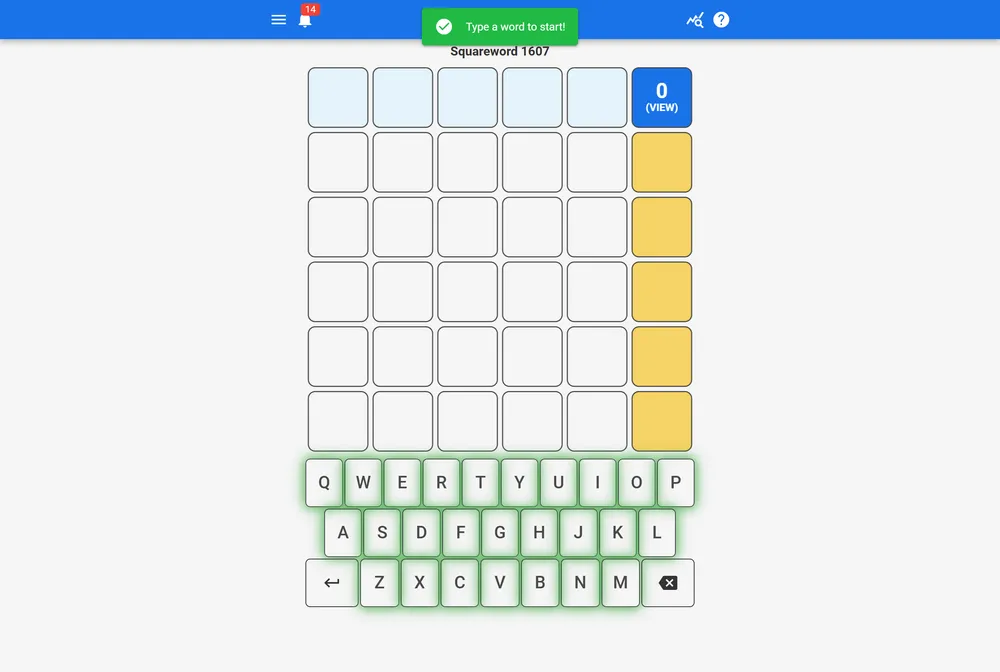
Squareword is a daily browser puzzle that packs ten words into one five-by-five grid: each of the five rows and each of the five columns spells a valid five-letter word. You type complete words, read green, yellow, and grey feedback on every cell of the grid, and try to fill the whole square in as few guesses as possible. It is a Wordle-style game with a crossword-shaped twist, where every letter you place answers two clues at once.
What is Squareword?
Squareword is a daily word puzzle built around a five-by-five grid in which every one of the five rows and every one of the five columns spells a valid five-letter word. That means a single completed board hides ten interlocking answers at once: five across and five down. You solve it by typing complete five-letter words and reading the colored feedback that appears across the whole grid, treating the puzzle as one connected logic problem where every cell belongs to both a horizontal answer and a vertical answer.
The mechanic that sets Squareword apart is this two-directional constraint. In a standard Wordle-style game you chase one hidden word; here every letter you place sits at the crossing of a horizontal word and a vertical word, so a single correct cell helps confirm two answers simultaneously. When you submit a guess, the grid updates with color feedback on each cell: green marks a letter that is correct and in its final position, yellow marks a letter that belongs somewhere in that line but sits in the wrong spot, and grey marks a letter that does not appear there. As greens lock in, the crossings narrow the possibilities for neighboring rows and columns, and the grid gradually resolves into a tidy block of real words.
Rather than racing against a fixed six-row board the way Wordle does, Squareword scores you on how many guesses it takes to fill the entire square. The focus is efficiency: each completed word, plus the crossings it reveals, should push you closer to finishing the whole grid in as few entries as possible. Different versions and write-ups describe the rules slightly differently, so if you want the exact submission and scoring behavior for the build you are playing, the official site is the place to confirm it. When you finish, the game reports your result, the kind of compact, shareable summary that fits naturally into a daily puzzle routine.
The game lives at squareword.org and is free to play in a browser, with no download or account required to start solving. A fresh puzzle appears every day and rotates at local midnight, so everyone works the same grid on a given date. It is an independent, single-grid daily rather than a product from a large publisher, which is part of its appeal for people who like a focused logic puzzle. It tends to draw crossword fans, Wordle players who want a denser challenge, and anyone who enjoys squeezing a full board of real words out of one five-by-five grid each day.
How to play Squareword
- Open the five-by-five grid at squareword.org, where each of the five rows and each of the five columns hides a valid five-letter word.
- Type any valid five-letter word and submit it; the guess goes into the grid and the game then shows color feedback across every cell, reflecting both the across and the down solution words.
- Read the color feedback on each cell: green means the letter is correct and in place, yellow means it belongs somewhere in that line but in a different spot, and grey means it does not appear there.
- Use confirmed green cells at the crossings to deduce letters in the intersecting rows and columns, since every cell answers both an across and a down word.
- Keep entering words, refining the grid guess by guess, until all five rows and all five columns read as real words.
- Aim to complete the square in as few guesses as you can, since your guess count is your score for the day.
Tips and strategy
- Because letters must satisfy both a row and a column, treat every green cell as a clue for two words at once and work the crossings rather than one line at a time.
- Open with vowel-heavy words to light up many cells quickly and reveal where vowels sit across the whole grid.
- Pay attention to grey letters per line, since they prune the candidates for that specific row or column even when the letter exists elsewhere on the board.
- Use yellow letters as placement hints: they confirm a letter belongs in a line, so test where it fits given the columns it must also satisfy.
- Prioritize guesses that fill rows and columns where you already have the most green confirmations, so each new word resolves multiple uncertain cells at once.
- Spend an early guess purely to gather information, using a word that probes many fresh letters before you commit to filling in a tightly constrained line.
Good to know
- Resets
- Daily, at local midnight
- Cost
- Free, no download or account
- Grid
- 5x5, with 5 across and 5 down words (10 total)
- Scoring
- Based on how many guesses it takes to fill the whole grid
- Platform
- Browser, at squareword.org
- Languages
- English
Squareword FAQ
Is Squareword free?
Yes. Squareword is free to play in a web browser at squareword.org, with no download and no account required.
How many guesses do you get in Squareword?
You keep entering five-letter words until the whole grid is solved, and your final guess count is your score, so the aim is to finish in as few guesses as possible. Some versions and write-ups mention a cap on attempts, so check the official site for the exact rules of the build you are playing.
When does Squareword reset?
A new puzzle appears every day and rotates at local midnight, so all players work the same daily grid on a given date.
Do both rows and columns have to be words in Squareword?
Yes. Every one of the five rows and every one of the five columns must spell a valid five-letter word, so a finished board contains ten interlocking words: five across and five down.
Is Squareword related to Wordle?
It is inspired by Wordle's daily-guessing format and its green, yellow, and grey feedback, but it is a separate game. Squareword expands the idea into a five-by-five crossword-style grid where every letter must satisfy both a horizontal and a vertical word at once.