Pedantle
Reveal a Wikipedia intro word by word.
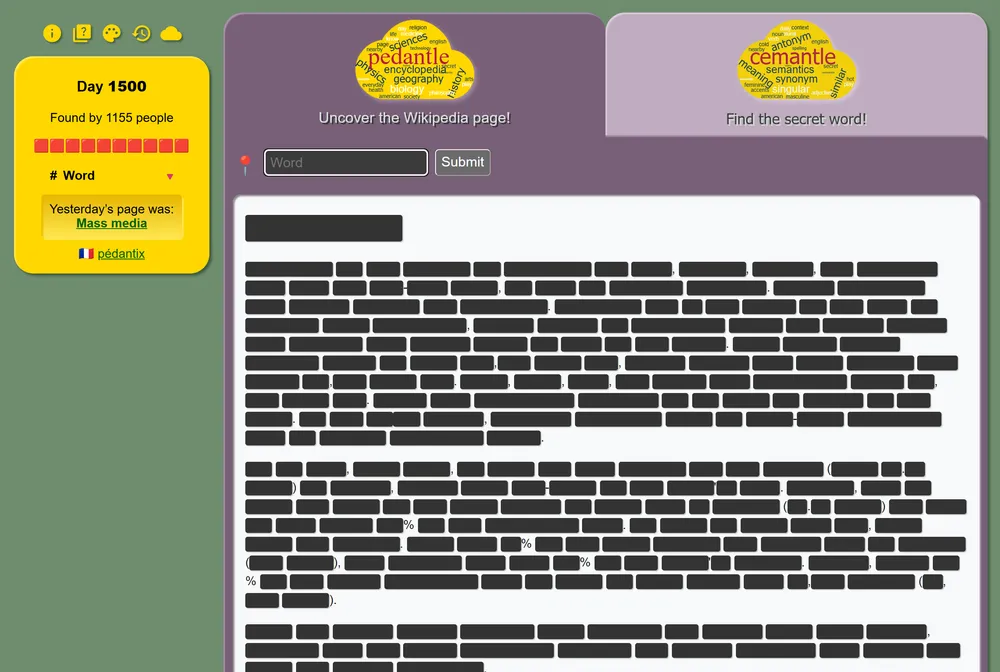
Pedantle is a daily word game built on a single redacted Wikipedia article: its title and entire introduction are hidden behind boxes, and you uncover them by guessing words. Every word you type is revealed wherever it appears, and other guesses are scored by how semantically close they are, so you rebuild the text piece by piece until you can name the page. It is free, resets once a day, and gives you unlimited guesses.
What is Pedantle?
Pedantle is a daily browser game that turns a random English Wikipedia article into a redaction puzzle. At the start of each round the title and every word of the article's introduction are replaced by gray boxes sized to the length of the hidden words, and your job is to peel that censorship away one word at a time. You type words into a single input box, and any word you enter is filled into every box where it actually appears, so the page slowly resolves from a wall of blanks into readable sentences.
What separates Pedantle from a straight Redactle-style blackout game is its semantic feedback. Each guess is color coded: green means the word is present in the text and has been revealed, orange means your word is very close to a word that appears in the article, and red means it is not in the text at all. The orange signal is the clever part, because it nudges you toward a synonym or a near spelling without handing you the answer. You are not just hunting for exact matches, you are reading the meaning of your guesses against the meaning of the hidden vocabulary, which is why an obscure topic can still be cracked through related terms.
Pedantle belongs to the Semantle family of word games. David Turner created the original Semantle, the developer known as enigmatix built the French page-guessing game Pedantix, and Pedantle is the English-language version, with secondary sources crediting a creator going by Julie (an attribution that is not confirmed on the official site). Its closeness scoring comes from a Google word2vec model, while the puzzle article itself is drawn from English Wikipedia. The game lives at pedantle.certitudes.org, is maintained by enigmatix, and has run as a daily puzzle for well over a thousand consecutive days. It shares its site and look with sister games like Cemantle, the semantic single-word cousin.
There is no penalty clock counting your mistakes and no cap on attempts, so Pedantle rewards patience over speed. You can keep entering words even after you correctly name the title, which lets you fully reconstruct the intro for the satisfaction of a clean, fully green page. When you finish you get a congratulations screen showing your guess count and time, and a shareable summary you can post without spoiling the answer. Because it has no timer and no strike limit, it plays as a slow-paced reading puzzle rather than a fast reflex game, and it asks you to reverse-engineer a Wikipedia article from its scaffolding outward.
How to play Pedantle
- Open Pedantle and look at the redacted article, where the title and the whole introduction are hidden as gray boxes shaped to the hidden words.
- Type a word into the guess box and submit it to reveal every spot in the text where that exact word appears.
- Read the color feedback: green means the word is in the article and now shown, orange means you are very close to a word in the text, and red means it is not present.
- Follow the orange hints by trying synonyms or words with similar meaning or spelling until you turn them green.
- Use the revealed words and sentence shapes to work out the article's subject, then guess the title once the topic is clear.
- Optionally keep guessing after you name the title to fully uncover the intro, then share your guess count and time.
Tips and strategy
- Open with very common words like the, of, and, was, and is to expose the article's grammatical skeleton before you even know the topic.
- Treat orange as a near-miss compass: brainstorm synonyms and related forms of that word, since the exact term is semantically close to what you tried.
- Once a theme appears, pour in field-specific vocabulary, because a science, geography, or history article will reward its own jargon quickly.
- Try both singular and plural forms and different tenses, as the article may use a specific inflection that your first guess missed.
- Watch where revealed words cluster, since dense green patches often mark the defining sentence that names the subject directly.
- Do not rush the title guess: a wrong topic guess costs you nothing, but reading more revealed context usually beats a blind stab.
Good to know
- Resets
- Daily, one new Wikipedia article per day
- Cost
- Free to play in the browser
- Guesses
- Unlimited, no attempt cap or strike limit
- Language
- English Wikipedia (sister game Pedantix is French)
- Scoring
- Word closeness from a Google word2vec model
- Archive
- Past daily puzzles available via the history option
Pedantle FAQ
Is Pedantle free?
Yes. Pedantle is free to play in any web browser at pedantle.certitudes.org, with no account or payment required.
How many guesses do you get in Pedantle?
There is no limit. You can enter as many words as you like, and you can even keep guessing after you correctly name the title to finish uncovering the intro.
What do the colors in Pedantle mean?
Green means the word appears in the article and has been revealed, orange means your guess is semantically very close to a word in the text, and red means the word is not in the article at all.
Is Pedantle related to Wordle?
Not directly. Pedantle comes from the Semantle family started by David Turner, and it guesses a whole Wikipedia article rather than a five-letter word, so it uses meaning-based feedback instead of letter position.
Is there a Pedantle archive?
Yes. The site offers a history option that lets you reach previous daily puzzles, so you are not limited to only the current day's article.