Smashdle
Guess the Super Smash Bros. fighter.
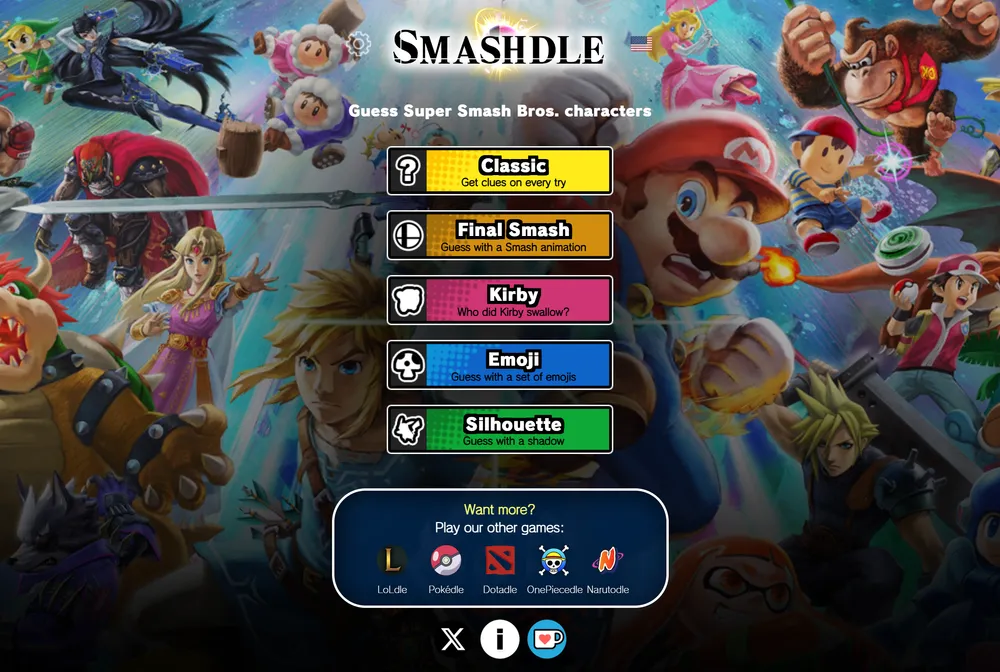
Smashdle is a daily guessing game that asks you to name the secret Super Smash Bros. Ultimate fighter of the day. After each guess, a grid compares your fighter to the hidden answer across traits like universe, weight, species, and the Smash game they debuted in, so you can close in clue by clue. One fighter, the same for everyone, with a fresh challenge each day across five different modes.
What is Smashdle?
Smashdle is a daily browser puzzle built around the Super Smash Bros. Ultimate roster. Instead of spelling a word, you are trying to name one secret fighter, and the only way in is to keep naming other fighters and reading how they compare to the hidden answer. Every player worldwide works on the same fighter on the same day, which is what turns a private guessing session into a shared daily ritual.
The core of the game is its attribute grid. When you submit a fighter, Smashdle lines up several traits side by side: the universe or series the fighter comes from, gender, species such as human, robot, or dragon, a weight or build value, the number of jumps, and which Smash game the fighter first appeared in. Each trait is marked to show how it lines up with the secret fighter, and the numeric traits add an arrow so you learn whether the true answer sits higher or lower than your guess on that value. You are not decoding letters, you are narrowing the roster by game-canon facts. That is the main thing that sets Smashdle apart from letter-based Wordle clones: the puzzle rewards franchise knowledge, not vocabulary.
Smashdle is also more than one puzzle. Alongside the Classic attribute mode, it runs themed modes that change how the clue is presented. Final Smash asks you to name the fighter from a description of their ultimate move, Kirby mode shows you the copy ability and asks who Kirby swallowed to get it, Emoji mode hides a fighter behind a short string of emoji, and Silhouette mode reveals a blacked-out outline that you try to identify in as few guesses as possible. Each mode is its own small daily challenge, so a regular visit can stretch from a quick single answer into a five-part round of trivia.
The vibe is friendly and fan-made rather than slick and corporate. It is free to play in the browser with no account needed, the daily puzzle resets on a fixed schedule, and a typical session is short enough to fit into a coffee break. Difficulty scales with how well you know the roster: casual Smash players can usually triangulate the universe and zero in from there, while the deep-cut fighters and the silhouette and emoji modes give longtime fans something to chew on. It suits anyone who likes the Smash series and enjoys a low-stakes daily that they can compare with friends.
How to play Smashdle
- Open Smashdle in your browser and pick a mode, starting with Classic if you are new.
- Type any Super Smash Bros. Ultimate fighter into the box and select the name from the dropdown to lock in your guess.
- Read the attribute grid, where each trait is colored to show how it compares with the secret fighter across universe, gender, species, build, jumps, and debut game.
- Watch for an exact match in green, a near miss in a partial-match color, and no overlap in red, and treat a partial match as a strong steer toward the right area rather than a dead end.
- Follow the arrows on numeric traits like weight to learn whether the answer sits higher or lower than your guess, then use what each row rules out to choose a sharper next fighter.
- Repeat until you name the secret fighter, then switch to the Final Smash, Kirby, Emoji, and Silhouette modes for separate daily challenges using the same one-fighter-per-day format.
Tips and strategy
- Lead with a guess from a big franchise such as Mario, Pokemon, or Zelda, because confirming or eliminating a crowded universe in one move clears the most ground.
- Once the universe turns green, switch to fighters inside only that series so every later guess is testing a real candidate rather than wasting a turn.
- Read the weight arrow and the debut-game clue together, since two fighters from the same series often split apart cleanly by build and by when they joined Smash.
- Treat species as a hard filter: a robot, dragon, or non-human result quickly removes large blocks of the human-heavy roster.
- Do not waste a partial-match clue: if a trait comes back as a near miss rather than a full match, steer your next guess toward neighboring options instead of abandoning that lead.
- In Silhouette mode, look at proportions and signature shapes like a hat, cape, or tail before guessing, because the outline gives away more than the lack of color suggests.
- In Emoji and Kirby modes, anchor on the fighter's most iconic trait, such as a recognizable move or copy ability, instead of trying to read every symbol literally.
Good to know
- Resets
- Daily at 06:00 UTC
- Cost
- Free
- Roster
- Super Smash Bros. Ultimate fighters
- Modes
- Classic, Final Smash, Kirby, Emoji, Silhouette
- Platform
- Web browser, no download or account
- Format
- One shared secret fighter per day for all players
Smashdle FAQ
Is Smashdle free?
Yes. Smashdle plays in your browser at no cost, and you do not need an account or any download to start.
When does Smashdle reset?
The puzzle refreshes once a day at 06:00 UTC, when every mode gets a new secret fighter to find.
Is Smashdle related to Wordle?
It borrows the daily-guessing idea from Wordle, but instead of letters you compare Super Smash Bros. fighters by traits like universe, weight, species, and debut game, so it tests roster knowledge rather than spelling.
What Smash characters does Smashdle use?
The answers are drawn from the Super Smash Bros. Ultimate roster, which is why early guesses that pin down a fighter's universe are so useful.
How many modes does Smashdle have?
There are five modes: Classic attribute guessing, Final Smash, Kirby, Emoji, and Silhouette, each running as its own daily challenge.
How does the Classic mode color feedback work?
Each trait is colored after a guess: green means it matches the secret fighter exactly, red means no overlap, and a partial-match color flags a trait that is close but not an exact hit, which is a useful nudge toward the right area.