Runedle
Guess the Old School RuneScape answer from attribute hints.
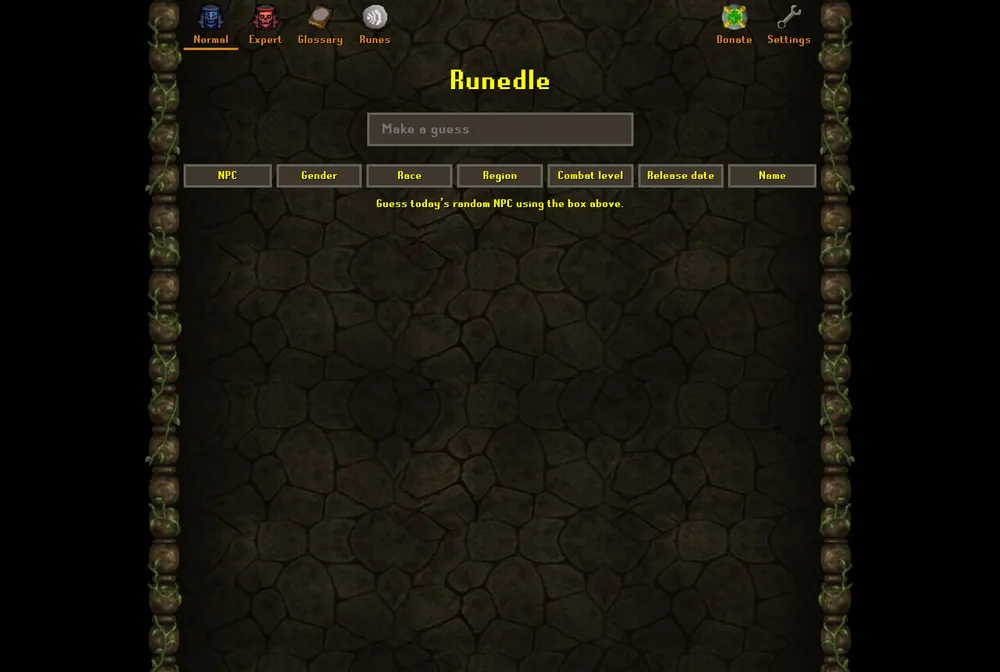
Runedle is a daily browser puzzle built for Old School RuneScape fans: each day it locks in one secret character from the game's bestiary and challenges you to name it using attribute clues instead of letters. You guess by typing the name of a monster or NPC, and the game grades how close that pick is to the hidden answer across a row of trait fields. Everyone playing on a given day chases the same target until the next reset.
What is Runedle?
Runedle belongs to the attribute-comparison branch of the daily puzzle family rather than the letter-guessing branch. Where the original Wordle asks you to spell a five-letter word, Runedle asks you to identify a specific RuneScape creature or NPC. Each guess is a complete character, and the board responds by lining up that character's traits next to the secret answer's traits. The result is a deduction game where you are reasoning about who a character is, not how their name is spelled. Note that there is also a separate site at runedle.app built around guessing RuneScape locations; this entry covers the character-guessing game at runedle.com.
The feedback runs across a row of attribute fields drawn from how OSRS describes its monsters and NPCs. Combat level appears to be one of the categories players lean on, and other fields are likely pulled from standard creature traits, though the exact column lineup is not documented on any public page. Color is how the board communicates: shared result grids show green squares where a guess matches the answer on a given field and red squares where it does not. Some daily character games of this style also use directional hints on numeric fields so you can tell whether the true value sits higher or lower than your guess, which would steadily narrow the field, but Runedle's precise feedback for numbers is not confirmed by any source we could verify.
Runedle is themed entirely around Old School RuneScape, so the fun depends a lot on how well you know Gielinor's creatures, from low-level chickens and goblins to high-end bosses. Shared results circulating online show roughly six attribute squares lined up per guess, and players have posted wins in a handful of attempts, so the puzzle rewards efficient deduction. When you finish, Runedle produces a spoiler-free grid of colored squares you can copy and post, letting friends compare how many guesses each of them needed without revealing the answer. The single shared daily target means everyone is chasing the same character until the next reset.
Because the game leans on in-game knowledge rather than reflexes, it fits current OSRS players, returning veterans, and anyone who enjoys trivia-style deduction over Gielinor's bestiary. A round usually takes only a few minutes. Newcomers to RuneScape may find it tougher than a plain word game, since the clues assume some familiarity with how the game's monsters and NPCs differ from one another, while seasoned players can often reason from a creature's combat level and other traits straight to a short list of candidates.
How to play Runedle
- Open Runedle in your browser; one OSRS character is set as the hidden answer for the day, the same for every player.
- Type the name of any RuneScape monster or NPC as your first guess and submit it.
- Read the row of attribute fields that appears next to your guess, where combat level is one of the traits being compared against the secret answer.
- Treat green fields as confirmed matches and red fields as misses, then use those results to rule characters in or out.
- Refine your next guess using the clues you have, steering toward characters that satisfy every confirmed attribute.
- Keep guessing until the whole row turns green, then copy your color-coded result grid to share your score.
Tips and strategy
- Lead with combat level as your compass, since it is a core comparison field; a clearly low or clearly high opening guess quickly tells you which tier of creature the answer sits in.
- Pick characters you know well for early guesses so you can confidently read each field, rather than naming an obscure monster whose traits you are unsure of.
- Once a field locks green, list out the characters that share that exact trait and test from within that pool instead of guessing at random.
- Choose a recognizable mid-tier creature as an opener so the results have room to push you in either direction rather than pinning you at one extreme.
- When two fields lock green but you are still stuck, brainstorm every character that fits both at once; the overlap is usually small enough to test directly.
- Keep a mental note of which guesses came back all red, since ruling out a whole region of the bestiary is just as useful as a partial match.
Good to know
- Type
- Daily Old School RuneScape character guessing game
- Resets
- Once per day; a new character each day
- Cost
- Free to play in a browser
- Feedback
- Attribute fields per guess, including combat level
- Grid
- Shared results show green and red squares, about six per row
- Sharing
- Copyable color-coded result grid
Runedle FAQ
Is Runedle free?
Yes. Runedle plays in a web browser at no cost and does not require a purchase to take part in the daily puzzle.
How many guesses do you get in Runedle?
There is no publicly confirmed guess cap. Shared result grids show about six attribute squares per guess, which is the number of trait fields per row rather than a limit on attempts, and players have posted wins in a handful of tries. Check the board in your own round to see how it behaves.
When does Runedle reset?
Runedle is a once-per-day game, so a new character becomes the target after the daily reset. Everyone shares the same answer until that rollover.
Is Runedle related to Wordle?
It is inspired by Wordle's daily, one-answer-for-everyone format, but it is an attribute-comparison game. Instead of guessing letters, you guess an Old School RuneScape character and compare traits such as combat level against the hidden answer.
What do I actually guess in Runedle?
You guess Old School RuneScape characters, meaning its monsters and NPCs. Each guess is graded across a row of attribute fields, with combat level among the traits the board compares to the secret answer.