Pokedoku
Fill a Pokemon grid matching each rule.
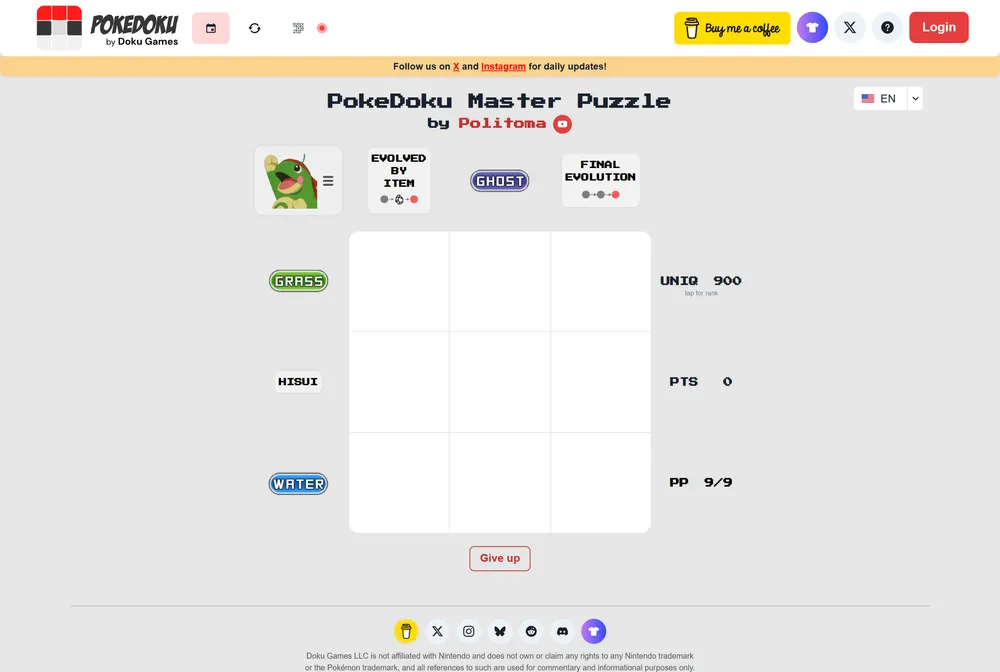
Pokedoku is a daily Pokemon take on the classic nine-square grid puzzle. Each day you get a three by three board with a category on every row and every column, and you fill each cell with a Pokemon that fits both clues where they cross. The same board is shared by everyone that day, and the real test is completing all nine cells without ever repeating a Pokemon.
What is Pokedoku?
Pokedoku takes the familiar nine-cell grid format and fills it entirely with Pokemon. Three categories run down the left as row clues and three run across the top as column clues, and every one of the nine cells sits at the intersection of one row clue and one column clue. To fill a cell, you name a Pokemon that satisfies both clues at once: if the row says Water type and the column says Kanto, you need a Water type from the Kanto region. Categories pull from types, generations, regions, evolutionary stages, and special forms such as Legendary or Mega, so a single board can ask you to cross a typing with a region or a generation with a status.
What sets Pokedoku apart from word-guessing games is that there is no hidden answer to deduce letter by letter. The grid and its clues are visible from the start, and the difficulty comes from recall and the no-repeat rule. You may use each Pokemon only once across the whole board, so a versatile creature that could fit several cells forces a decision about where to spend it. You get nine guesses total, one per cell, and a placement cannot be undone, which makes every pick feel committal. The board is identical for every player on a given day, so scores are directly comparable.
Scoring is where Pokedoku rewards depth rather than speed. After you finish, each correct answer shows the percentage of players who chose the same Pokemon, and your overall score combines those percentages. A lower combined rarity means a higher score, so common, obvious answers will complete the grid but leave you with a high percentage and a weaker result, while accurate but unusual picks earn a better score. This uniqueness mechanic turns the game into a contest of how obscure you can go while still being correct, and the shareable result lets you compare your rarity score against friends.
Pokedoku was created by two longtime Pokemon fans, Ryan and Joe, who build and run it under Doku Games LLC, an independent project that is not affiliated with Nintendo or The Pokemon Company. A new daily board appears at midnight Eastern time, and the game is free to play in a browser with no account required. Beyond the daily puzzle, an Unlimited mode lets you generate endless Pokemon grids with custom categories, which is handy for drilling rarer combinations and getting extra rounds in once the daily board is done. The vibe is relaxed but genuinely testing for the breadth of franchise knowledge it asks for, making it a natural fit for longtime Pokemon fans, competitive trivia players, and anyone who enjoys a quick daily logic break.
How to play Pokedoku
- Read the three row categories down the left side and the three column categories across the top of the grid.
- Choose a cell and think of a Pokemon that satisfies both its row clue and its column clue, such as a Fire type that is also a Legendary.
- Type the Pokemon name into that cell and confirm it, remembering that categories can cover types, generations, regions, evolutions, and forms like Mega or Legendary.
- Use each Pokemon only once across the entire board, and note that a placement cannot be changed once it is locked in.
- Spend your nine guesses to fill as many of the nine cells as you can, since wrong picks still use up a guess.
- When the board is full or your guesses run out, review your rarity score to see how unique your correct answers were.
Tips and strategy
- Start with the cells whose two crossing clues are narrowest, because tightly constrained intersections have the fewest valid Pokemon and pin down the rest of the board.
- Aim for correct but uncommon Pokemon, since the scoring counts how many players matched your answer and rarer picks lower your percentage for a better score.
- Hold back any versatile Pokemon that could fit several cells until you confirm where its typing or region is hardest to satisfy elsewhere.
- Map out a few candidates for the whole grid before committing, because the no-repeat rule means a Pokemon spent early can leave a later cell unsolvable.
- Watch for cells that combine a typing with a region or generation, since these often have a short list of answers that is easy to overlook under pressure.
- If you only care about completion, fill obvious cells with common answers first, but accept that those safe picks will raise your rarity percentage and weaken your score.
Good to know
- Resets
- Daily at midnight Eastern time
- Cost
- Free to play in a browser
- Guesses
- Nine, one per cell on the 3x3 grid
- Creator
- Ryan and Joe, under Doku Games LLC
- Unlimited mode
- Custom-category grids you generate on demand
- Platform
- Web browser, no account required
Pokedoku FAQ
Is Pokedoku free?
Yes. Pokedoku is free to play in a web browser at pokedoku.com, and you do not need to create an account to play the daily board.
How many guesses do you get in Pokedoku?
You get nine guesses, one for each cell of the three by three grid. Each placement uses a guess and cannot be undone, so wrong picks count against you.
When does Pokedoku reset?
A new daily board is released at midnight Eastern time. The same puzzle is shared by every player for that day.
What is Pokedoku Unlimited mode?
Unlimited mode lets you generate endless Pokemon grids with custom categories, which is useful for practicing rarer combinations and playing more rounds beyond the single daily board. It is a custom-grid generator rather than an archive of past daily puzzles.
Is Pokedoku related to Wordle?
It shares the daily, same-for-everyone, shareable format popularized by Wordle, but the gameplay is different. There is no hidden answer to deduce; you fill a visible grid by matching Pokemon to row and column categories.