Pokegrid
Fill a Pokémon grid matching each rule.
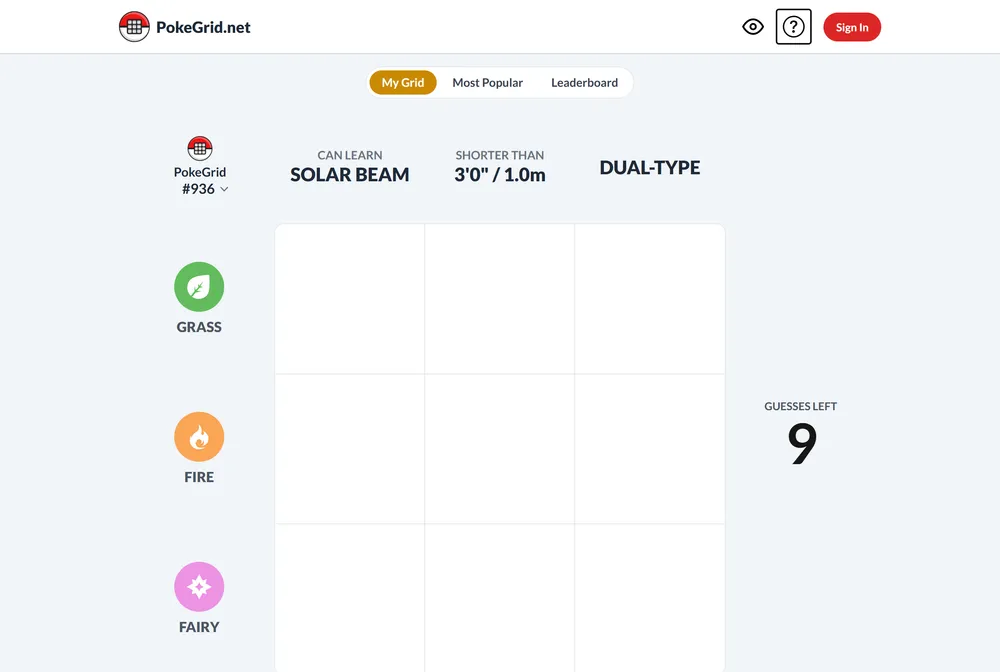
Pokegrid is a daily Pokemon grid puzzle where three row rules cross three column rules to form a nine-cell board, and every cell needs a Pokemon that satisfies both the rule above it and the rule beside it. It plays in the Pokedoku style, but its heart is the rarity score: you do not just want a correct Pokemon, you want a correct one that almost nobody else thought of. One fresh grid drops each day for every player to attempt.
What is Pokegrid?
At its core, Pokegrid takes the familiar grid-logic format and fills it with Pokemon knowledge instead of geography or sports trivia. The three labels down the side and the three across the top are drawn from categories like elemental types, regional dex origins, and special classifications such as legendary, mythical, and ultra beast. Each of the nine cells sits at the intersection of one row rule and one column rule, so a single cell might demand, for example, a Water-type that also comes from a particular region. You can draw on Pokemon from any generation, which keeps the answer pool wide and rewards players who remember the deeper cuts as well as the famous faces.
What separates Pokegrid from a plain Wordle clone is that being right is only half the game. After you lock in an answer, the game later shows you the percentage of other players who chose the same Pokemon for that exact cell, and your goal is to keep those percentages low. A common, obvious pick scores poorly even when it is technically valid, while a correct but obscure choice earns a strong rarity result. This turns each cell into a small wager: you are weighing whether a clever, lesser-known Pokemon will hold up against the rule, rather than reaching for the first name that pops into your head.
Pokegrid runs at pokegrid.net and bills itself as a daily Pokemon grid game with a Sudoku-like logic feel. It is one of several Pokemon grid puzzles that share the format popularized by Pokedoku, and the site does not publicly credit a named individual creator. It states that it is not officially affiliated with Pokemon or Nintendo. Over time it has added light social features, including optional accounts and the ability to create private leaderboards so you can compare daily rarity scores with friends.
The vibe is relaxed but quietly competitive. There is no timer pressure baked into the basic puzzle, so casual fans can enjoy filling all nine squares with valid Pokemon, while completionists chase the lowest possible rarity total and bragging rights on their friend leaderboard. Difficulty swings with the day's rule combinations: some grids are forgiving and others force tight overlaps that leave very few legal answers. That mix makes it appealing both to lapsed players who just want to test their childhood Pokemon recall and to dedicated fans who treat the rarity score as a daily optimization problem.
How to play Pokegrid
- Open Pokegrid and study the three row labels along the left and the three column labels across the top of the nine-cell board.
- Click an empty cell, then search for a Pokemon that satisfies both that cell's row rule and its column rule at the same time.
- Submit your pick, which locks into the cell permanently, since answers cannot be swapped once placed.
- Move through the remaining cells, using a different Pokemon for each one because no Pokemon may repeat across the grid.
- Fill all nine cells to complete the day's grid, drawing on any generation to find legal matches.
- Review the post-game results to see the rarity percentage on each pick and your overall uniqueness score, then share or compare it with friends.
Tips and strategy
- Solve the most constrained cell first, where two narrow rules barely overlap, so you do not burn a rare answer on a slot that has many valid options.
- Treat correctness and rarity as separate goals: confirm a Pokemon legally fits both rules, then ask whether a less obvious choice would also fit and score lower.
- Lean on the full National Dex, since older or less popular Pokemon that still satisfy a rule usually carry much lower popularity percentages than the obvious starters and legendaries.
- Watch for cells where one Pokemon could satisfy several intersections, and deliberately spend it on the toughest cell so easier cells get your spare rare picks.
- Because each pick is locked the moment you submit, hesitate before committing an answer you are unsure about rather than guessing and wasting a cell.
- Use the last 7 days of past grids to practice recognizing how the same category types recur, which sharpens your instinct for low-popularity answers on the live daily grid.
Good to know
- Resets
- New grid daily
- Cost
- Free to play
- Cells / picks
- 9 cells, one Pokemon each, no repeats
- Archive
- Past grids from the last 7 days
- Accounts
- Optional login with private friend leaderboards
- Platform
- Browser, at pokegrid.net
Pokegrid FAQ
Is Pokegrid free?
Yes. Pokegrid is free to play in a web browser at pokegrid.net, with an optional account if you want to use friend leaderboards.
How many guesses do you get in Pokegrid?
There are nine cells and you place one Pokemon in each, so you fill nine squares total. Every answer locks the moment you submit it and cannot be changed, and no Pokemon may be used twice in the same grid.
How does scoring work in Pokegrid?
Each cell shows the percentage of players who chose the same Pokemon you did. Lower percentages are better, so the game rewards correct answers that few other people picked rather than the most obvious match.
Is there a Pokegrid archive?
Yes. You can play past grids from the last 7 days by selecting an earlier date through the icon at the top-left of the board.
Is Pokegrid related to Wordle?
It is part of the daily-puzzle wave that Wordle popularized, but it is not a word game. Pokegrid is a Pokemon grid puzzle in the Pokedoku style, built around matching Pokemon to crossing row and column rules and scoring on how unique your picks are.