Padlock
Crack the four-digit number combination.
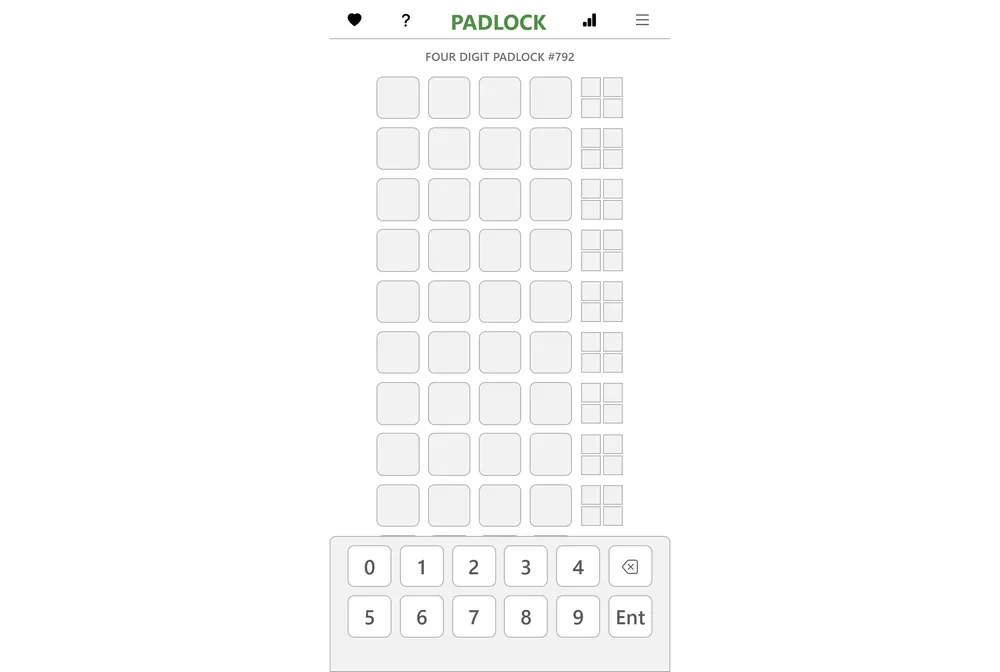
Padlock is a daily code-cracking puzzle where you try to open a locked combination by guessing its hidden digits. Each morning a new secret code appears, and you have ten attempts to work it out. The catch is that the color feedback tells you how many digits are right, not which ones, so you have to reason your way to the answer.
What is Padlock?
The core loop is simple to describe and hard to master. Each day the game generates a new secret combination, four digits in the standard mode and five in the advanced mode, and digits are allowed to repeat. You type a number guess and submit it, and the game replies with a row of color-coded mini-blocks: green means a correct digit sitting in the correct position, yellow means a correct digit that belongs somewhere else in the code, and gray means a digit that is not in the code at all. From there you narrow the possibilities guess by guess until the padlock opens.
What sets Padlock apart from Wordle and the wide field of -dle clones is that the feedback is deliberately not positional. The green, yellow, and gray blocks do not line up with the digits you typed. They only report a running count of each result type, so a row might tell you that two digits are correct and in place without telling you which two. That single design choice removes the positional hint Wordle players lean on and turns the game into a stricter logic exercise. You are not reading the board so much as deducing from it, cross-referencing guesses and eliminating options until only one code can be true. Anyone who has played Mastermind or Bulls and Cows will recognize the shape of it immediately.
Padlock was created by Elizabeth Wilson and coded by her husband Mark, and the pair drew directly on Mastermind for inspiration. That heritage shows in the pace: it rewards patience and careful bookkeeping rather than quick pattern spotting. The game also sits at the center of a small family. DUOLOCK asks you to solve two Padlock combinations at once, in either a number or a word form, and ALPHALOCK swaps the digits for letters to make a word variant of the same format. Those are separate games rather than modes tucked inside the page, but they share the same count-only feedback idea.
The overall vibe is quiet and methodical. You get ten attempts, which is enough room to test theories without feeling generous, and the standard four-digit code is approachable while the five-digit advanced mode gives more experienced solvers something to chew on. It is free to play in the browser, and because a fresh combination arrives each day, it works well as a short daily habit rather than a session you binge. If you enjoy the deduction half of Wordle more than the vocabulary half, Padlock leans hard into that side.
How to play Padlock
- Open Padlock at padlockgame.net in your browser.
- Read the day's secret code length, four digits in standard mode or five in the advanced mode, and remember that digits can repeat.
- Enter a full number guess and submit it as your first attempt.
- Read the color feedback as counts only: green for correct digit in the correct spot, yellow for correct digit in the wrong spot, gray for a digit not in the code, without assuming which digit each block refers to.
- Use each result to eliminate impossible codes and refine your next guess, working logically across your previous rows.
- Keep going until you crack the combination or use all ten attempts.
Tips and strategy
- Treat the feedback as a tally, not a map. Because the blocks are not positional, note only how many greens and yellows a guess earned and reason from the totals.
- Open with a guess that uses several different digits so you can quickly learn which numbers are in the code at all.
- Follow up by testing whether a confirmed digit is present again, since digits are allowed to repeat and a repeat can be easy to miss.
- When a guess returns all gray, cross every one of those digits off your list for good and reuse that freedom on the next attempt.
- Change only one thing at a time between guesses when you are narrowing position, so any shift in the green count points at a single cause.
- Keep written notes of which digits are confirmed present and which are ruled out, especially in the harder five-digit advanced mode.
Good to know
- Category
- Logic
- Resets
- Daily, a new combination each morning
- Cost
- Free to play in the browser
- Guesses
- 10 attempts
- Modes
- Standard 4-digit and advanced 5-digit
- Creator
- Elizabeth Wilson, coded by Mark Wilson
- Platform
- Browser (also a Daily Digit Puzzle iOS app)
- Related games
- DUOLOCK and ALPHALOCK
Padlock FAQ
Is Padlock free?
Yes. Padlock is free to play in the browser at padlockgame.net, with no pricing shown on the site.
How do you play Padlock?
Each day there is a hidden numeric combination, four digits in standard mode or five in advanced mode. You have ten guesses, and after each one you get color feedback: green for a correct digit in the correct position, yellow for a correct digit in the wrong position, and gray for a digit not in the code. The feedback only gives counts and does not say which digit it applies to, so you deduce the code by elimination.
When does Padlock reset?
A new combination appears every morning, so there is one fresh puzzle per day. The exact reset time and timezone are not stated on the site.
Is Padlock like Wordle?
It shares the daily guessing format and green, yellow, gray color feedback, but with a key difference. The feedback blocks are not positional. They only tell you how many digits are correct in place, correct elsewhere, or absent, not which ones, which makes it closer to Mastermind or Bulls and Cows than to Wordle.
Who made Padlock?
Padlock was created by Elizabeth Wilson and coded by her husband Mark, inspired by the classic game Mastermind.