Daily Triplets
Deduce the hidden math rule by testing three-digit numbers.
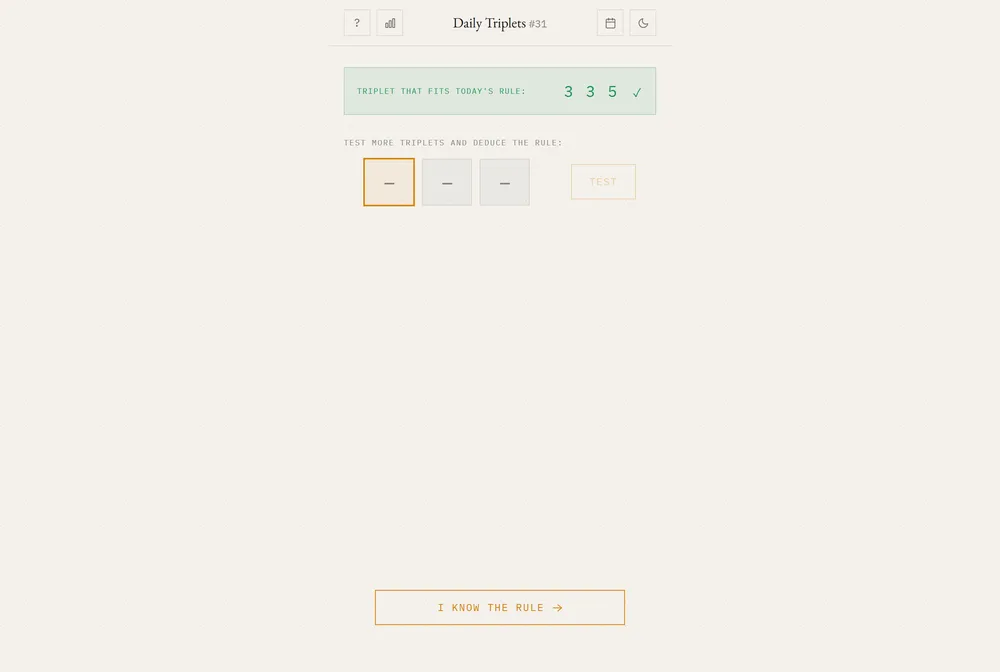
Daily Triplets gives you one hidden mathematical rule each day and asks you to figure out what it is. You do this by typing in triplets of digits and reading whether each one satisfies the rule or not. It is a puzzle about forming a hypothesis and then testing it, based on Peter Wason's well-known 2-4-6 psychology experiment.
What is Daily Triplets?
At its core, Daily Triplets is a rule-induction puzzle. Every calendar day there is one secret mathematical rule that decides which sets of three numbers get accepted. You do not guess a word or a picture. You probe an abstract pattern. The game's own instruction text puts it plainly: "A secret mathematical rule determines which triplets of numbers are accepted." Your job is to work out what that rule is by experimenting.
The loop is simple to describe and takes real thought to play. You type any three digits from 0 to 9, and the game tells you whether that triplet fits the rule with a checkmark, or fails it with an X and shows a counterexample. There is no cap on how many triplets you can test. The on-page text reads: "Enter any three digits (0 to 9) and see whether they satisfy the hidden rule. Use the results to narrow down what the rule could be. There's no limit on tests." Once you believe you have cracked it, you press "I know the rule" and write the rule out as a mathematical condition, an expression that has to contain a comparison such as =, <, or >. Your equation is then checked against all the triplets. You get three attempts to state it correctly.
This is what sets it apart from Wordle-style games. Those give you hot-and-cold color feedback against a single fixed answer, and you win by landing on that exact answer. Daily Triplets works differently. The answer is a rule, not a target value, so you win by articulating the logic itself. Because you have unlimited exploratory tests, the real challenge is resisting the temptation to only try triplets you expect to pass. That is the confirmation-bias trap Wason's 2-4-6 task was designed to expose, and it is the heart of the puzzle here. The site's meta description names the lineage directly: "Find the hidden rule by testing triplets that either fits the rule or don't. Daily math puzzle game inspired by the Wason's 2-4-6 task."
The presentation is plain and focused. There is one daily puzzle, plus a stats and streak view, a calendar that lets you go back and play or review past days, a how-to-play screen, and a light or dark theme toggle. A "Copy Result" button copies a short text summary of your run, labeled "Daily Triplets #N", so you can share it. The game is free, with an optional "support on ko-fi" link if you want to support the creator. The creator is not named on the site. The Ko-fi handle is "dailytriplets", and the page's Open Graph URL points at dailyrule.game, which suggests the same person runs more than one daily rule puzzle.
How to play Daily Triplets
- Open Daily Triplets at dailytriplets.com.
- Read the short how-to, which explains that a secret mathematical rule decides which triplets are accepted.
- Type any three digits from 0 to 9 as a test triplet and submit it.
- Read the feedback: a checkmark means the triplet fits the rule, an X means it does not and shows a counterexample.
- Keep testing as many triplets as you want, using the results to narrow down the pattern.
- Press "I know the rule" and write the rule as a mathematical condition using a comparison such as =, <, or >. You have three attempts to state it correctly.
Tips and strategy
- Do not only test triplets you expect to pass. Deliberately try ones you think should fail, because a rejected triplet often tells you more than an accepted one.
- Change one number at a time between tests so you can isolate which digit or relationship the rule actually cares about.
- Once you have a candidate rule in mind, actively look for a triplet that would break it. If you cannot find one, your hypothesis is stronger.
- Test edge cases like 0, three identical digits, or an increasing versus a decreasing sequence to expose how the rule handles boundaries.
- There is no limit on tests, so spend them freely before committing. You only get three attempts to state the rule, and those are the scarce resource.
- When you write the rule, keep the expression as simple as the evidence allows. The intended rule is usually broader and plainer than the specific pattern you first noticed.
Good to know
- Category
- Logic
- Resets
- Daily, one new puzzle per calendar day
- Cost
- Free, with optional Ko-fi support
- Guesses
- Unlimited test triplets, then 3 attempts to state the rule
- Modes
- Single daily puzzle, plus stats, calendar, and how-to views
- Archive
- Yes, calendar lets you play and review past days
- Feedback
- Checkmark or X with a counterexample, plus a Copy Result share summary
- Launched
- 2026, earliest embedded puzzle dated June 1, 2026
Daily Triplets FAQ
Is Daily Triplets free?
Yes. It is free to play with no paywall. There is an optional "support on ko-fi" link (ko-fi.com/dailytriplets) if you want to support the creator.
How do you play Daily Triplets?
You type any three digits from 0 to 9 and the game tells you whether that triplet satisfies the day's hidden mathematical rule. You test as many triplets as you like, then press "I know the rule" and write out the rule as a mathematical condition. You get three attempts to state it correctly.
When does Daily Triplets reset, and is there an archive?
A new puzzle appears each calendar day. There is also a calendar archive, so you can go back to play or review past daily puzzles and then return to the current one.
Is Daily Triplets like Wordle?
Not really. Wordle gives color feedback against one fixed hidden answer. Daily Triplets asks you to deduce an abstract mathematical rule using unlimited test triplets, and you win by writing the rule out. It is based on Wason's 2-4-6 confirmation-bias task rather than word guessing.
Who made Daily Triplets?
The creator is not named on the site. The support link uses the Ko-fi handle "dailytriplets", and the page's Open Graph URL points to dailyrule.game, which suggests the same creator runs more than one daily rule puzzle.