FoodGuessr
Guess the country from a local dish.
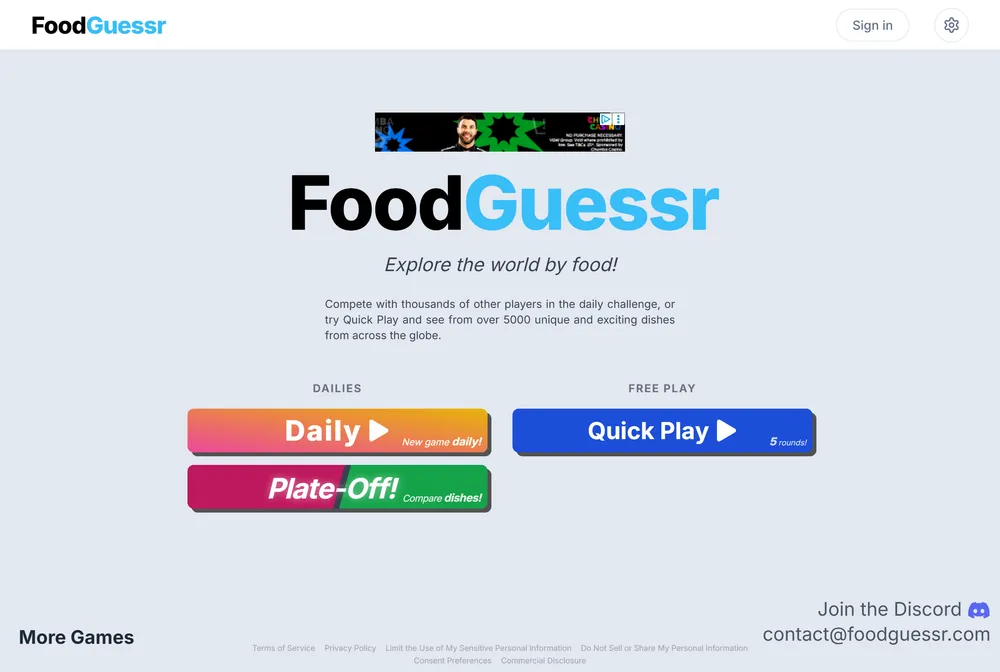
FoodGuessr hands you a photo of a real dish and asks one deceptively hard question: which country does it come from? Every day brings three fresh rounds, each a new plate, and your score depends on naming the right country in as few guesses as possible. It is a daily food geography puzzle that rewards a sharp eye for ingredients and plating over pure trivia.
What is FoodGuessr?
FoodGuessr is a daily food geography game built around a simple but tricky question: looking at a photo of a finished dish, can you name the country it comes from? Each day's challenge is made of three rounds, and every round shows a different dish along with notes on its ingredients and how it is prepared. You pick a country from a list grouped by continent, and the faster you land on the right answer, the more points you keep. The same three dishes are served to every player each day, which is what gives the game its shared, compare-your-score rhythm.
What sets FoodGuessr apart from the wider family of Wordle-style daily games is that it leans on visual and culinary knowledge rather than letters or pure geography. You are reading a plate instead of a five-letter grid: the breads, spices, sauces, and plating are your real clues, and the country list is your keyboard. After a wrong guess the game gives layered feedback rather than a flat miss. It tells you whether you are warm, hot, or very hot, and it adds compass direction and distance hints that nudge you toward the correct region. After two wrong tries it also reveals the dish name, which often unlocks the answer for anyone who recognizes the recipe by reputation even if the photo stumped them.
Scoring is generous but rewards confidence. A round is worth up to 5,000 points if you name the country on your very first guess, and each additional guess you need lowers what that round can pay out. Across the three daily rounds that puts a perfect day at 15,000 points, and the running total is what players screenshot and share to compare against friends. The dish pool is large, drawing from a catalog the site describes as over 5,000 unique dishes from around the world, so repeat dishes are rare and the daily set stays fresh. Beyond the headline daily challenge, the site offers a Quick Play mode of five rounds you can run as often as you like, plus a Plate-Off mode where you vote on which of two dishes is most liked globally.
The overall feel is relaxed and educational rather than cutthroat. Wrong guesses are never punished with a hard game over, since you simply lose potential points and learn something about a cuisine you did not recognize. Difficulty swings widely depending on the day: a national staple you have eaten before is easy, while a regional specialty plated in an unfamiliar way can send even confident cooks bouncing across continents. Because nothing is on the line beyond your score, it works well as a short daily break that leaves you with the name of a new dish to look up and maybe cook later.
How to play FoodGuessr
- Open the daily challenge and study the photo of the dish along with the notes on its ingredients and preparation.
- Choose the country you think the dish comes from, picking from the country list grouped by continent.
- If your guess is wrong, read the warm, hot, or very hot feedback plus the compass direction and distance hints, and use them to narrow toward the right region.
- Keep guessing the country, and note that the dish name is revealed after two wrong tries to give you a stronger lead.
- Lock in the correct country, ideally early, since the first correct guess in a round is worth up to 5,000 points and later guesses pay out less.
- Finish all three rounds, add up your total out of a possible 15,000, and share your score.
Tips and strategy
- Read the plate before the country list: identifiable staples like a specific bread, a chili paste, a fermented side, or a signature protein often pin a dish to one region faster than guesswork.
- Treat the warm, hot, very hot feedback plus the distance and compass hints as a search, not a coin flip, and move steadily toward the target instead of jumping between continents.
- Hold your guesses if you are unsure, because the dish name appears after two wrong tries and a recognizable recipe name can hand you the country outright.
- Spend your early guesses on your strongest read while points are high, since a first-try country is worth the full 5,000 for that round.
- Practice in the five-round Quick Play mode to build your eye for unfamiliar cuisines without spending your one daily attempt.
- When a dish looks generic, lean on plating and garnishes, since presentation style and accompaniments often reveal the country even when the main item is common worldwide.
Good to know
- Resets
- New daily challenge every day at midnight UTC
- Cost
- Free to play; sign-in is optional
- Rounds
- 3 rounds in the daily challenge, one dish per round
- Guesses
- Up to 5 country guesses per round
- Scoring
- Up to 5,000 points per round on a first correct guess, so 15,000 max per day
- Modes
- Daily Challenge, Quick Play (5 rounds), and Plate-Off (vote which dish is most liked globally)
FoodGuessr FAQ
Is FoodGuessr free?
Yes. FoodGuessr is free to play in a web browser, and signing in is optional rather than required to play the daily challenge.
How many guesses do you get in FoodGuessr?
You get up to five country guesses per round across three rounds. After two wrong guesses in a round, the dish name is revealed to help you.
How does scoring work in FoodGuessr?
A round is worth up to 5,000 points if you name the country on the first guess, and each extra guess lowers the points that round can earn. A perfect day across all three rounds is 15,000 points.
When does FoodGuessr reset?
A new daily challenge with three new dishes appears every day at midnight UTC, and the same set is shared by all players that day.
Is FoodGuessr related to Wordle or GeoGuessr?
It is not made by either, but it shares the once-a-day, share-your-score format of Wordle-style games and the guess-the-country idea of GeoGuessr, applied to photos of food instead of maps or words.