Primel
Guess the hidden prime number.
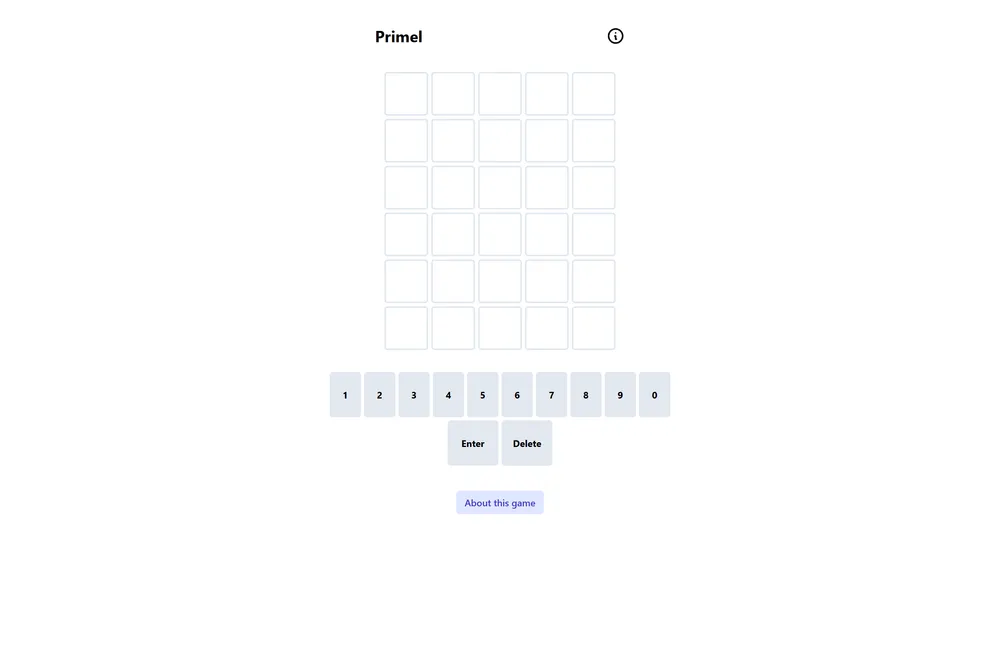
Primel is a daily number puzzle that runs on Wordle's rules but swaps letters for prime numbers. The answer is a hidden five-digit prime, every guess you enter must itself be a valid five-digit prime, and you have six tries to lock it in. It is a small math-flavored brain teaser for people who enjoy reading green, yellow, and gray clues like a logic problem.
What is Primel?
Primel asks one clean question every day: which five-digit prime is hidden behind the tiles? Whatever number you submit as a guess has to be a genuine five-digit prime itself, so the game checks your math before it ever checks your logic. Once a guess is accepted, the digits light up in green, yellow, and gray exactly the way Wordle's letters do, and you work from those clues toward the single answer of the day. Everyone playing on a given day chases the same target, which is what gives the result something to compare.
What separates Primel from the wider field of Wordle spinoffs is that the puzzle lives entirely in number theory rather than vocabulary. A word game lets you throw almost any letter combination at the board; Primel refuses anything that is not prime, so part of the challenge is simply holding a working set of five-digit primes in your head. That constraint does double duty. It narrows what you are allowed to type, and it quietly teaches you which numbers are prime as you play. The hidden answer is always prime too, which means a fact like 'primes above five never end in an even digit or in five' becomes a real, usable deduction rather than trivia.
Primel was made in 2022 by DL Miller, who publishes it on the personal site at converged.yt and goes by 'dill' on GitHub. Miller built it as an open-source project under the MIT license, forking an earlier Wordle clone by Hannah Park and pulling its list of primes from a reference maintained by the University of Tennessee at Martin. That lineage shows in the interface, which keeps the familiar Wordle grid and color scheme so anyone who has played the original can start immediately. The game has stayed a small, focused, hobbyist creation rather than a commercial product, and it has been mirrored and cataloged across many puzzle sites because of how cleanly the idea translates.
Feedback in Primel is per-digit and immediate: green means a digit is correct and correctly placed, yellow means it belongs in the answer but sits in the wrong column, and gray means it is absent from the target prime entirely. You read those three signals across six attempts and narrow toward the one prime that fits every clue. When you finish, the game produces an emoji grid you can copy and share without spoiling the digits, so friends see how many tries you needed but not the answer. The vibe is quiet and brainy: harder than a casual word game for most people, very satisfying for anyone comfortable with numbers, and a daily ritual aimed squarely at math fans, students, and puzzle solvers who like a logic problem with a single right answer.
How to play Primel
- Open the daily Primel puzzle; there is one shared five-digit prime to find each day.
- Type a valid five-digit prime as your opening guess. The game rejects any number that is not actually prime.
- Read the tile colors: green means the digit is right and in the correct spot, yellow means it is in the answer but a different spot, and gray means it is not in the target at all.
- Combine the clues to choose another valid five-digit prime that fits everything you have learned so far.
- Keep guessing, refining each attempt against the green, yellow, and gray feedback.
- Identify the hidden prime within six guesses, then copy the emoji grid to share your result without revealing the number.
Tips and strategy
- A prime greater than five can only end in 1, 3, 7, or 9, so treat the last digit as a four-way choice from your very first guess instead of a ten-way one.
- Open with a valid five-digit prime that packs in several different digits, since each distinct digit you test returns its own green, yellow, or gray signal and clears more of the board at once.
- Hold a small mental bank of go-to five-digit primes for early and mid-game; you cannot guess freely like in a word game, so having ready candidates saves you from getting stuck on what is even legal to type.
- Use gray tiles aggressively. Every grayed digit is banned from all five positions, which often eliminates whole families of primes you were considering.
- When a digit goes yellow, remember it cannot sit in the column where it just appeared, and pair that with the prime ending rule to rule out impossible placements quickly.
- If you have narrowed the answer to a few candidates, double-check each is actually prime before spending a guess, because an invalid number wastes the attempt by being rejected outright.
Good to know
- Category
- Math / number puzzle
- Guesses
- 6 attempts
- Answer
- A hidden five-digit prime
- Creator
- DL Miller (made 2022)
- Cost
- Free to play
- Source
- Open source, MIT license (forked from Hannah Park's Wordle clone)
Primel FAQ
Is Primel free?
Yes. Primel is free to play in the browser at converged.yt/primel, and it is an open-source project released under the MIT license.
How many guesses do you get in Primel?
You get six guesses to find the hidden five-digit prime, and every guess you submit must itself be a valid five-digit prime.
Is Primel related to Wordle?
Yes. Primel was inspired by Wordle and uses the same six-row grid and green, yellow, and gray tile feedback, but it was built independently by DL Miller and replaces letters with prime numbers.
Who made Primel?
Primel was created by DL Miller in 2022 and is published on the creator's personal site, converged.yt. It started as a fork of an earlier Wordle clone by Hannah Park and uses a prime list referenced from the University of Tennessee at Martin.
Does every guess have to be a prime number?
Yes. Primel only accepts five-digit prime numbers as guesses, so the game effectively checks your number is prime before scoring it against the hidden answer.