Chartle
Identify the country from a data chart.
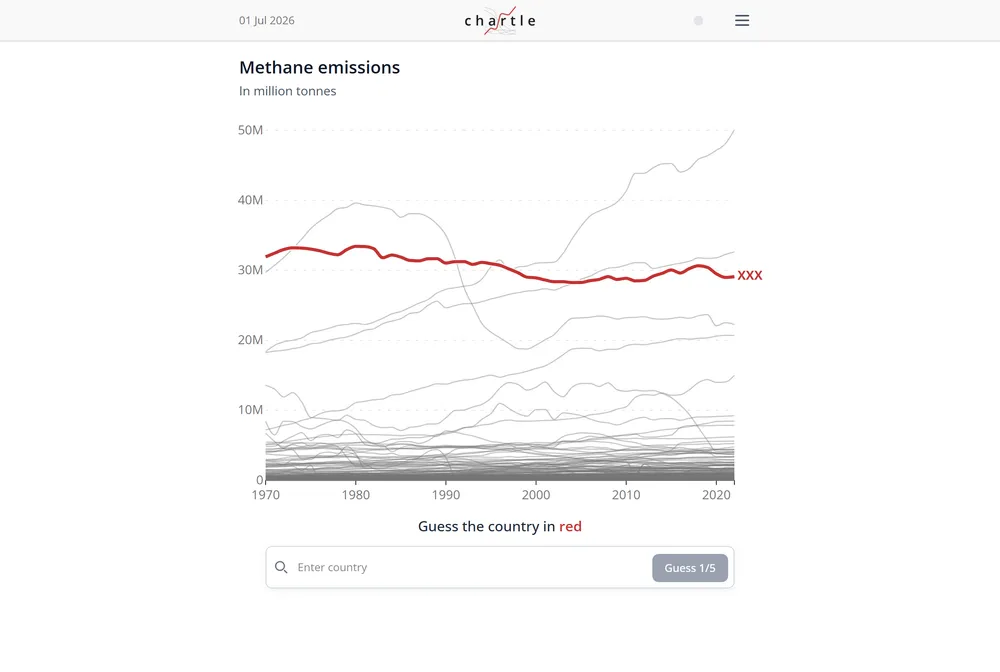
Chartle is a daily puzzle built around a single line chart. Each day the site plots a real-world statistic for many countries over time, with one country's line drawn in bold red, and your job is to figure out which country that red line represents. There is no map, no flag, and no label to help. You read the data and reason your way to the answer.
What is Chartle?
The core loop is short and repeatable. When you open Chartle you see one chart with a headline describing the metric, an x-axis for time, and a y-axis for the value. Faint gray lines trace how every country moved on that measure, and a single red line stands out from the pack. You study where the red line sits, how steeply it rises or falls, and how it compares to the others, then type a full country name as your guess. You have five attempts, and fewer guesses means a better result.
What sets Chartle apart from most geography guessing games is that it never shows you what a country looks like. Games that quiz country outlines, flags, or map positions test visual recognition. Chartle tests something different: your feel for world demographics, economics, and long-run trends. The metrics change from day to day, and the skill you lean on changes with the topic. A chart about livestock rewards different knowledge than one about migration.
The game was made by Erwan Rivault and Adnaan Jiwa, and it drew attention through coverage on FlowingData, a site focused on data visualization, in September 2025. That origin shows in the design. The charts are the whole experience, presented plainly rather than dressed up with extra game mechanics. There is one standard daily puzzle rather than a menu of modes, which keeps the focus on reading the graph in front of you.
Feedback is deliberately sparse. A wrong guess gives you nothing beyond what the chart already shows: no location hint, no proximity clue, and no automatic list of countries to rule out. Progress comes from re-reading the chart and using your own knowledge of regions, size, and economies to narrow the field. That restraint is a big part of the vibe. Chartle feels less like a race and more like a quiet reasoning exercise, closer to solving a small puzzle over morning coffee than chasing a streak. Each guess has to be a full country name, and you cannot repeat a country you already tried.
How to play Chartle
- Open Chartle at chartle.cc.
- Read the chart headline and axes to learn which statistic and time span you are looking at.
- Find the bold red line and study its level, shape, and trend compared to the gray lines around it.
- Think about which countries fit that pattern given world population, economy, and known trends, then type a full country name as your guess.
- Use your own reasoning after each wrong guess to rule out countries, since the game itself gives no extra hints, then re-examine the red line before trying again.
- Solve the chart in as few of your five guesses as you can, then return the next day for a new one.
Tips and strategy
- Read the headline first. Knowing whether the metric is a total, a rate, or a per-country figure changes which nations could plausibly own the red line.
- Check the y-axis scale before guessing. A very high absolute value often points to a large or populous country, while a rate can belong to a small one.
- Watch the shape of the red line, not just its height. A sharp spike or steady decline can match a specific historical event tied to one country.
- Compare the red line to the pack. If it sits far above every gray line, look for outliers. If it hugs the middle, favor mid-sized countries.
- Let the topic guide your shortlist. A commodity chart points toward major producers of that good, while a chart about people or populations points toward regions you associate with that trend.
- Spend your early guesses narrowing regions rather than gambling on one country, since the game gives no hints and each miss only helps if you reason from it.
Good to know
- Category
- Geography, data visualization
- Resets
- Daily, a new chart each day
- Cost
- Free
- Guesses
- Five attempts
- Modes
- Single standard daily puzzle
- Feedback
- None beyond the chart itself, no location or proximity hints
- Creators
- Erwan Rivault and Adnaan Jiwa
- Coverage
- Featured by FlowingData in September 2025
Chartle FAQ
Is Chartle free?
Yes. Chartle is free to play at chartle.cc, with no cost to try the daily puzzle.
How do you play Chartle?
You study a daily line chart of a real-world statistic where one country's line is highlighted in red, then guess which country that red line represents. You have five attempts, each guess must be a full country name, and fewer guesses gives a better result.
When does Chartle reset?
Chartle refreshes daily with a new chart, so there is one puzzle to solve each day.
Does Chartle give hints after a wrong guess?
No. A wrong guess gives you nothing beyond what the chart already shows. There are no location or proximity hints, so you narrow the field using your own knowledge of regions, size, and economies.
Who made Chartle?
Chartle was created by Erwan Rivault and Adnaan Jiwa, and it was covered by the data-visualization site FlowingData in September 2025.