Yeardle
Guess the year a historical event happened.
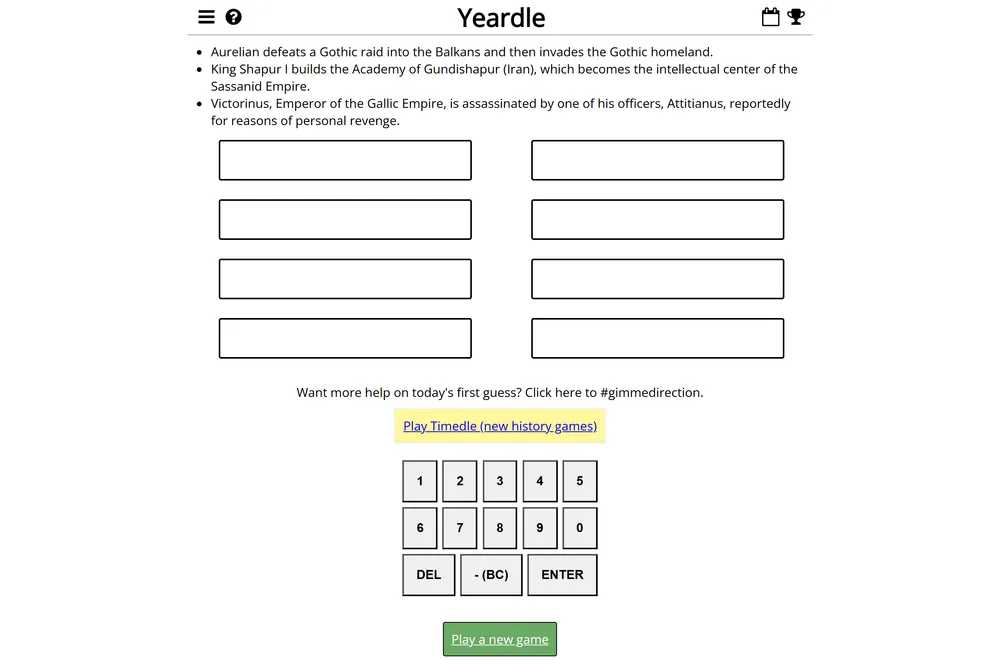
Yeardle hands you three real events that all share a single year and dares you to name it. You get eight guesses, and after each one your guess lights up in a color that warms as you close in on the truth. The game does not tell you which way to go, so you read the color and decide for yourself whether to aim higher or lower. Because BC dates are allowed with a minus sign, a puzzle can drop you into ancient Rome one day and the twentieth century the next.
What is Yeardle?
Yeardle is a daily history guessing game built around one clean idea: every puzzle shows you a small set of three things that genuinely happened in the same calendar year, and your job is to figure out which year that was. You type a year, and the game responds only with a color that signals how close you are. It is up to you to read that warmth and decide whether to move your next guess earlier or later. With only eight tries available, the challenge is less about knowing one exact date and more about triangulating from whatever clues you recognize.
What sets Yeardle apart from the wider family of Wordle-style games is that it is not about letters or vocabulary at all. Instead of arranging tiles into a word, you are placing yourself on a timeline that can stretch from deep antiquity to recent memory. The three-event format is the heart of it: one event might be obvious while the other two are obscure, so the puzzle rewards general historical awareness and the willingness to reason rather than rote recall. Negative years for BC dates push the range wide open, which keeps even confident history buffs honest.
Yeardle is part of the Histordle family, a small collection of guess-the-year games that also includes Songle for music, Moviedle for film, and PopCultured for mixed media. By the creator's own description the site is run by one person with a love of history, and the games share the same straightforward style. A new Yeardle is posted every day. Crucially, the feedback is color only: the box lights up in a different shade depending on how close your year is, and you interpret that distance yourself rather than being handed an arrow or a higher-or-lower message.
The feedback loop is quick, and the difficulty swings with the day's events: a year stuffed with famous milestones can fall in two or three guesses, while a quiet year of lesser-known happenings can push you to the edge of your eight attempts. Reading the color carefully matters, because it is your only signal for whether you overshot or undershot. If one puzzle a day is not enough, an Unlimited mode lets you keep playing back to back.
How to play Yeardle
- Open the daily Yeardle and read the three historical events listed, all of which happened in the same year.
- Type your first guess as a year, and add a minus sign in front for any BC date.
- Look at the color your guess lights up with: a warmer color means you are closer to the real year, and a cooler color means you are farther away.
- Decide for yourself whether to go higher or lower, since the game does not state the direction. Use whether the color warmed or cooled compared to your previous guess to judge which way the answer lies.
- Adjust your next guess based on that color reading, making bigger jumps when the color is cold and smaller moves when it is warm.
- Repeat until you name the exact year or until you use all eight of your tries.
Tips and strategy
- Lock onto the single event you can date most confidently first, then build your opening guess around that anchor so your very first color reading is meaningful.
- Treat the color as a distance meter: a guess that lights up warm tells you to make small moves, while a cold color means you should jump by hundreds of years.
- Because the game never tells you the direction, watch how the color changes between guesses. If a higher guess came back colder than a lower one, the answer sits below, so swing back the other way.
- Remember that BC years count: if warmer colors keep appearing as you guess earlier and earlier, do not stop at year one, push into negative numbers.
- When two of the three events look unfamiliar, anchor on the era they feel like rather than a precise year, since even a rough century narrows eight tries fast.
- If you want to practice reading the colors without spending your daily attempt, warm up in the Unlimited mode before tackling the day's puzzle.
Good to know
- Resets
- Daily at midnight Central Time
- Cost
- Free to play
- Guesses
- 8 attempts per puzzle
- Clues
- Three real events from the same year
- Feedback
- Color warmth only; you infer the direction
- Modes
- Daily puzzle plus an Unlimited mode
Yeardle FAQ
Is Yeardle free?
Yes. Yeardle is free to play in the browser, with no purchase required to take on the daily puzzle.
How many guesses do you get in Yeardle?
You get eight tries to land on the correct year. After each guess your year lights up in a color that warms as you get closer, and you decide which way to move next based on that color.
Does Yeardle tell you to guess higher or lower?
No. Yeardle only shows a color that reflects how close your guess is. It does not display an arrow or a higher-or-lower message, so judging the direction from the color warmth is part of the puzzle.
When does Yeardle reset?
A fresh Yeardle is posted every day at midnight Central Time, so a new set of three events appears once per day.
Is Yeardle related to Wordle?
It borrows the daily, guess-and-get-feedback format that Wordle made popular, but it is its own game about naming a historical year rather than spelling a word, and it comes from the separate Histordle project.
Can you play more than one Yeardle a day?
The main puzzle is once daily, but Histordle also offers a Yeardle Unlimited mode if you want to keep playing additional rounds back to back.