Historydle
Guess the daily historical figure or event.
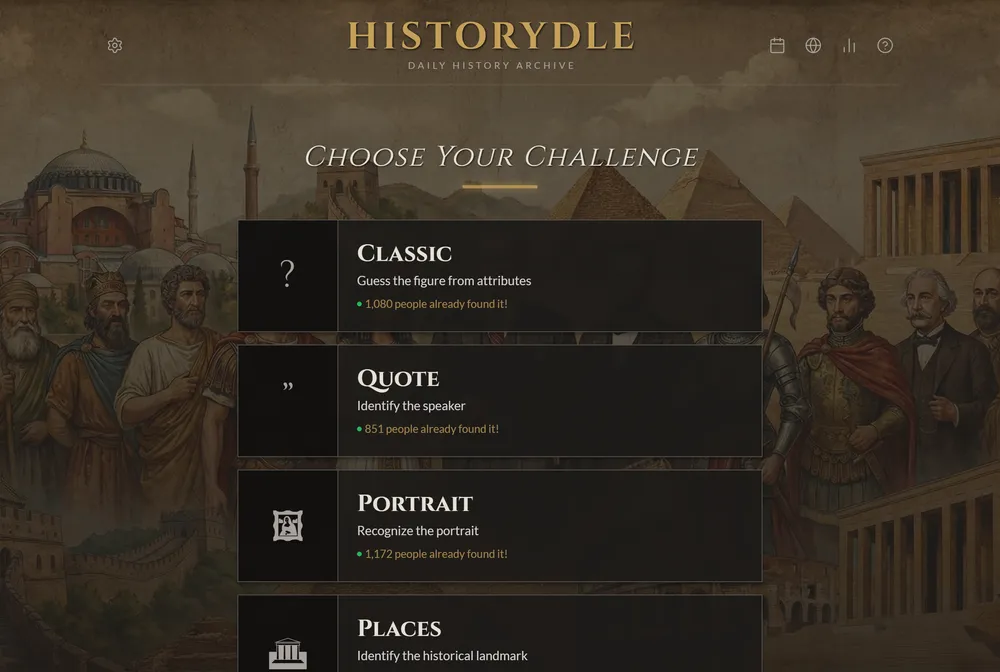
Historydle is a daily browser game that asks one deceptively simple question: which historical figure is hidden behind today's clues? Instead of guessing a five-letter word, you name a real person from the past and let color-coded feedback on traits like era, region, and role steer your next guess. It runs across four separate daily modes, so a single visit can swing from cold facts to a famous quote, a portrait, or a landmark.
What is Historydle?
Historydle takes the familiar daily-guessing formula and points it squarely at history. Each day a mystery historical figure is chosen, and your job is to identify the exact person by typing in names of real figures you know. After every guess the game compares your pick against the hidden answer across a set of attributes, then shows you how close you landed. The result is less about spelling and more about reasoning your way through centuries, continents, and the people who shaped them.
What sets Historydle apart from most other -dle games is that it is really four puzzles in one. The Classic mode reveals factual attributes such as era, region, role, gender, and status. The Quote mode hands you a famous line and challenges you to recognize who said it. The Portrait mode tests visual memory with an image of the figure, and the Places mode leans on landmarks tied to a person's life or legacy. Each mode runs its own fresh puzzle, so you can play one or work through all four for a fuller history workout. The answer is drawn from a pool of more than 199 real historical figures, broad enough to keep the daily picks varied across eras and regions.
Feedback follows the convention players already understand from word games, adapted for biographical traits. A green marker means an attribute is an exact match, yellow means you are close but not quite right, and gray means that path is wrong and can be ruled out entirely. Because the clues sharpen with each attempt, a wrong guess is still useful: it narrows the field and nudges you toward the right century, place, or profession. When you finally land the figure, the game reveals the full portrait or bio, and you can share your score based on how many guesses it took.
The overall vibe is brisk and educational rather than punishing, though pinning down an exact figure from limited traits can genuinely test your knowledge. The game presents one fresh puzzle per mode each day with no practice rounds, so the daily puzzle carries real stakes and rewards broad familiarity with world history. It suits trivia fans, students, teachers looking for a quick classroom warm-up, and anyone who enjoys connecting scattered facts into a single name. The public details about who publishes Historydle are limited, so this page focuses on what the game verifiably does rather than its origin story.
How to play Historydle
- Open historydle.com and choose a mode: Classic, Quote, Portrait, or Places.
- Read the opening clue, which may be a set of facts (era, region, role, gender, status) or a single quote, portrait, or landmark.
- Type the full name of any historical figure as your guess and submit it.
- Read the color-coded feedback: green for an exact attribute match, yellow for close, and gray for no match.
- Use what the colors rule in and out to refine your next guess, repeating until you identify the hidden figure.
- Solve the puzzle to reveal the full portrait or bio, then share your score showing how many guesses you needed.
Tips and strategy
- In Classic mode, lead with a well-known figure who sits squarely in a common era and region, so the first round of green and yellow markers gives you wide coverage.
- Treat yellow markers as directional hints: a near match on era or region tells you to shift earlier, later, or to a neighboring part of the world rather than abandon the lead.
- Use gray results aggressively to eliminate whole categories, such as a wrong era or status, instead of testing similar figures one at a time.
- For Quote mode, focus on the tone and subject of the line; political, scientific, and literary quotes each point to very different kinds of figures.
- In Portrait and Places modes, lean on visual and geographic memory, since recognizing a face or a landmark can let you solve in a single guess.
- Play all four modes the same day to reinforce a figure from multiple angles, which builds the broad recall that makes future puzzles easier.
Good to know
- Resets
- Daily, with one fresh puzzle per mode at midnight
- Cost
- Free to play
- Modes
- Four: Classic, Quote, Portrait, and Places
- Figure pool
- More than 199 real historical figures
- Feedback
- Color-coded: green (exact), yellow (close), gray (no match)
- Shareable result
- Yes, your score based on number of guesses
- Platform
- Web browser at historydle.com
Historydle FAQ
Is Historydle free?
Yes. Historydle is free to play in a web browser at historydle.com, with a new puzzle each day in every mode.
When does Historydle reset?
Historydle resets daily at midnight, when one fresh puzzle becomes available for each of its four modes. There are no practice rounds, so each day's puzzle is your one attempt per mode.
What are the modes in Historydle?
There are four: Classic, which reveals facts like era, region, role, gender, and status; Quote, built around a famous line; Portrait, which uses an image; and Places, which centers on landmarks tied to a figure.
How does the feedback work in Historydle?
After each guess, attributes are color-coded. Green means an exact match, yellow means you are close, and gray means no match, so you can rule that path out.
Is Historydle related to Wordle?
Historydle is not made by Wordle's publisher, but it borrows the daily format and color-coded feedback idea and applies it to guessing historical figures rather than words.