Puckdoku
The NHL version of the player grid.
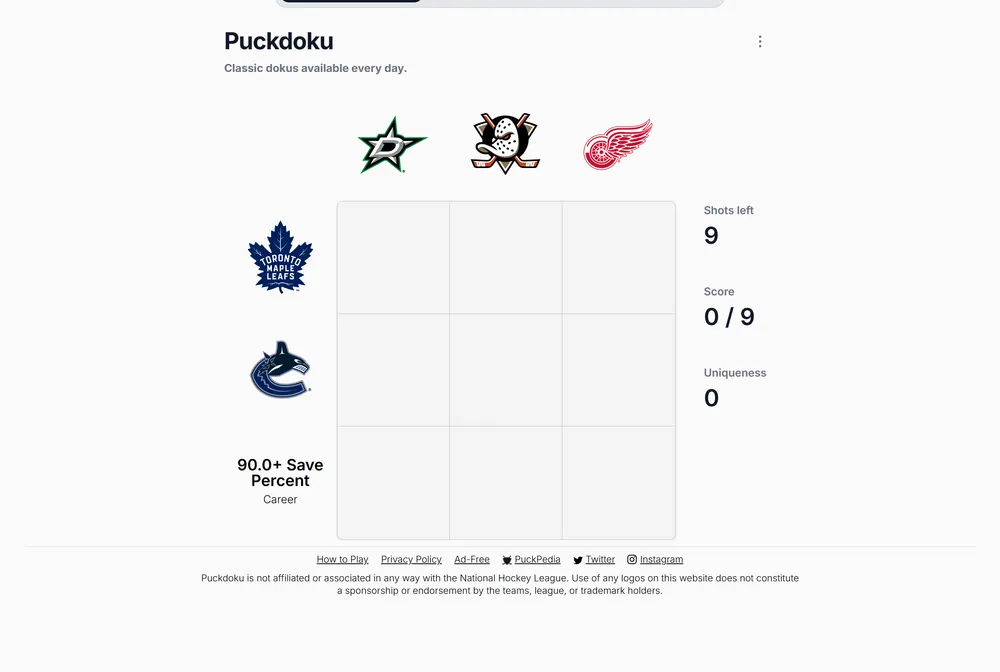
Puckdoku is a daily NHL grid puzzle that turns a 3x3 board into a deep-cuts hockey trivia test. The three rows and three columns each carry a label, usually a team but sometimes an award, a stat threshold, or a country, and every one of the nine cells needs a player who satisfies the row and the column where they cross. You get nine guesses, one per cell, and the rarer your correct pick, the better your score.
What is Puckdoku?
Puckdoku is the hockey entry in the sports-grid genre popularized by Immaculate Grid, built specifically around NHL history. At its core is a single daily board: a 3x3 grid whose rows and columns are each tagged with a criterion. Most labels are franchises, but the game mixes in awards like the Hart or Norris Trophy, statistical milestones such as a career goal or point total, draft details, and nationality. Your job in each empty cell is to name a player who satisfies both intersecting labels, for example a player who suited up for both the team on the row and the team on the column, or a Boston Bruin who also reached a listed scoring mark.
What sets Puckdoku apart from Wordle-style word games is that there is no hidden answer and no letter feedback. Instead of guessing one secret solution, you are recalling real players from decades of league history, and almost every cell has many valid answers. The twist is the rarity score: when you place a correct player, the game shows the percentage of other users who chose that same player. A common, obvious pick carries a high percentage, while a deep, obscure correct answer can land at a fraction of a percent. Lower is better, so the real challenge is not just being right but being uniquely right.
Your total score is built from those per-cell percentages. Each correct pick contributes its own rarity percentage to your running total, and every cell you leave empty or get wrong adds a fixed 100 to that total. Because the score is a sum and a lower number is better, a full board of obscure but correct answers beats a board with blank squares, and a perfect game means filling all nine cells while keeping each pick's percentage as low as you can. Puckdoku partners with PuckPedia, the hockey contract and salary-cap reference site, whose data backs the grids; that partnership was announced in April 2024. Puckdoku is not affiliated with the NHL, and its creator is not publicly attributed. There is a free version, and an ad-free experience offered through Patreon for supporters.
A new puzzle is released every day, and the same board is shared by everyone, which is what makes the rarity percentages meaningful and the results worth comparing. When you finish, you get a summary that highlights the day's popular picks and shows which players the community used for each square. That shareable recap, combined with your total rarity score, is the heart of the social loop: friends compare not only how many cells they filled but how clever their answers were. The vibe is brainy and nostalgic, rewarding fans who remember journeymen, trade-deadline rentals, and one-season call-ups. Casual fans can usually fill a few squares, while die-hards chase a perfect nine cells at the lowest possible score.
How to play Puckdoku
- Open the day's grid and read the label on each of the three rows and three columns, noting which are teams, awards, stats, or countries.
- Pick a cell and think of an NHL player who satisfies both that cell's row label and its column label at the same time.
- Click the cell, search for that player by name, and submit your choice to lock it into the square.
- Check the rarity percentage that appears with your correct pick, where a lower number means fewer players chose the same answer.
- Continue filling cells, remembering that each player can be used only once across the whole board and a submitted cell cannot be changed.
- Use all nine guesses to fill as many cells as you can, keeping in mind that each empty or wrong square adds 100 to your total, then review the end summary and share your result.
Tips and strategy
- Attack the toughest intersection first, where two demanding labels meet, while your full roster of usable players is still available and nothing is locked up.
- Lean on journeymen and well-traveled veterans, since players who suited up for many franchises unlock several hard team-by-team crossings.
- When more than one correct answer comes to mind, choose the more obscure player on purpose to drive your rarity percentage down and improve your score.
- Fill every square you can, even with a safe pick, because each empty cell adds a flat 100 to your total that no clever guess elsewhere can offset.
- Read every label type carefully, because award and stat-threshold squares behave differently from team squares and often have fewer eligible names.
- Track which players you have already placed, since the once-per-board rule means burning a flexible star early can leave you stuck on a later cell.
- Remember that relocated franchises count as one continuous team, so a player from an earlier city still qualifies for that franchise's current label.
Good to know
- Resets
- Daily, one new grid per day
- Cost
- Free, with an ad-free option via Patreon
- Guesses
- 9 total, one per cell
- Grid
- 3x3, rows and columns labeled with teams, awards, stats, or countries
- Data partner
- PuckPedia (partnership announced April 2024)
- Scoring
- Sum of pick percentages plus 100 per empty cell, lower is better
Puckdoku FAQ
Is Puckdoku free?
Yes. Puckdoku is free to play, and it offers an ad-free version through Patreon for supporters.
How many guesses do you get in Puckdoku?
You get nine guesses, one for each of the nine cells on the 3x3 grid. Once you submit a cell it locks and cannot be changed.
How does the Puckdoku score work?
Each correct player adds its rarity percentage, equal to how many other users picked that same answer, to your total, while every empty cell adds a fixed 100. The score is the sum, and a lower number is better, so unusual correct picks and a full board score best.
Is Puckdoku related to Wordle?
Not directly. It is a daily puzzle in the spirit of Wordle and Immaculate Grid, but it tests NHL knowledge on a player grid rather than guessing a hidden word with letter feedback.
Can a player be used more than once in Puckdoku?
No. Each player can be placed in only one cell per board, so you have to spread your picks across all nine squares.