Hoopgrids
Fill an NBA grid matching each pairing.
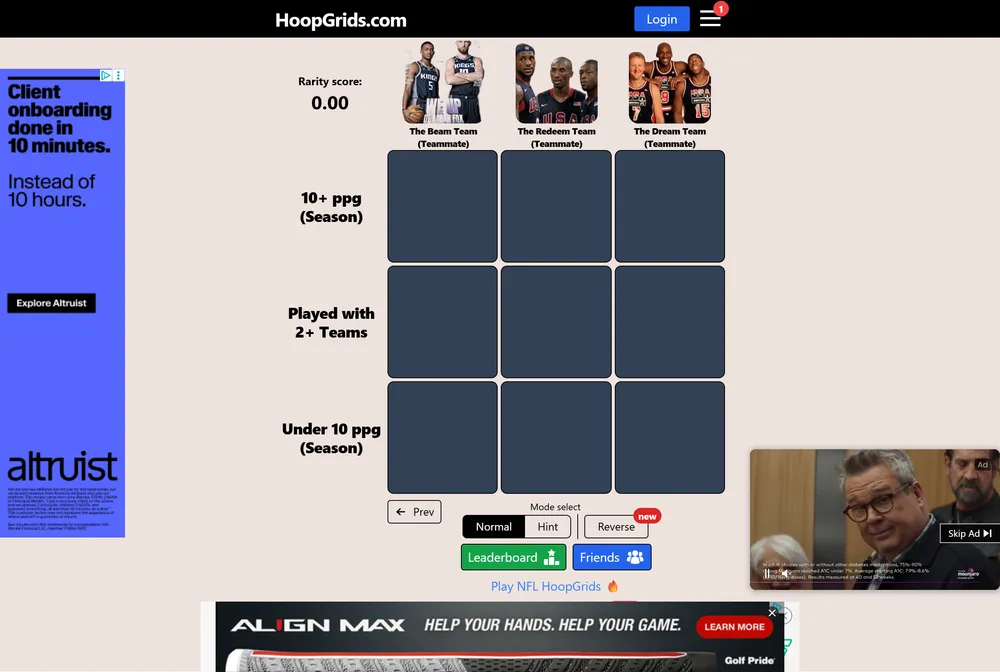
HoopGrids is a daily NBA puzzle that turns the immaculate grid into a basketball memory test: a three-by-three board where every cell must be filled with a player who satisfies both its row and its column label. The twist is that finishing the grid is only half the game, because each answer is scored by how rare your pick was, so the real flex is naming players almost nobody else thought of.
What is Hoopgrids?
HoopGrids is a daily basketball trivia puzzle built around a three-by-three grid. Each of the three rows and three columns carries an NBA label, which might be a franchise like the Boston Celtics, an award such as MVP or Defensive Player of the Year, or a career marker like a 20,000-point scorer. The nine empty cells sit where a row and a column intersect, and your job in each one is to name a player who satisfies both labels at once. If the row says Lakers and the column says Heat, a player who suited up for both teams, such as LeBron James, completes that square.
What separates HoopGrids from a typical Wordle-style game is that there is no single hidden answer to deduce. Most cells have dozens of valid players, so the real contest is not whether you can find someone who fits, but how obscure that someone is. The game scores every correct answer with a rarity percentage equal to the share of all players that day who used the same name for that cell. A widely chosen star carries a high percentage, while a deep-bench journeyman who still checks both boxes carries a tiny one. Lower is better, your nine cell scores are summed into a total, and the answers get sorted into seven rarity tiers: Starter, All-Star, All-NBA, MVP, HoF, Legend, and the elite GOAT band reserved for picks under roughly 0.05 percent.
HoopGrids grew out of the immaculate grid format that spread across sports fandom in 2023, taking the connect-two-criteria idea popularized in baseball and rebuilding it specifically around NBA rosters, awards, and statistical milestones. It has since grown into a small family of related daily grids and trivia formats under the same brand, but the core NBA grid at hoopgrids.com remains the flagship. Each puzzle is the same for everyone on a given day, which is what makes the rarity scoring meaningful: your percentages are measured against the actual crowd of people solving the identical board.
The result you can share is a compact recap of your grid: which tiers your nine answers landed in and your overall rarity score, with the player names hidden so you do not spoil the puzzle for friends. The vibe rewards genuine basketball depth over speed, since the difference between a casual fill and a great board is knowing the role players, short-stint trades, and forgotten one-season cameos that almost nobody else remembers. It suits NBA history buffs, but the grid is approachable enough that a casual fan can still complete most cells with mainstream names.
How to play Hoopgrids
- Read the two NBA labels attached to an empty cell, one inherited from its row and one from its column.
- Name a player who satisfies both labels at the same time, for example someone who played for both listed franchises or who won the listed award while on the listed team.
- Submit a player for each of the nine cells, remembering that any given player can be used only once across the whole grid.
- Watch each correct answer get a rarity percentage based on how many other people picked the same player for that cell.
- Aim to fill all nine cells while keeping your total rarity score as low as possible.
- Compare your tiers and total against the day's crowd, then share the spoiler-free result grid.
Tips and strategy
- Solve the hardest two-label intersection first, while your pool of eligible players is still wide and you have not yet spent obvious names elsewhere.
- Favor obscure but valid players over superstars, since a journeyman who quietly fits both labels scores far lower than the household name everyone defaults to.
- Watch the no-reuse rule when a star qualifies for several cells; save him for the square where no rare alternative exists and cover the easier cells with deep-roster names.
- Mine short stints and trade-deadline cameos, because a player who appeared in only a handful of games for a listed team still counts and is rarely chosen.
- For award-and-team crossings, think about lesser-known winners of that award rather than the famous one, as the marquee winner is the most common pick.
- Lean on your own NBA history knowledge rather than copying widely shared answers, since the crowd-popular pick is by definition the one that hurts your rarity score most.
Good to know
- Category
- Sports trivia (NBA)
- Resets
- Daily, a new grid each day at 8:00 PM ET
- Cost
- Free to play
- Grid
- 3x3, nine cells to fill
- Scoring
- Rarity score, lower is better; seven tiers from Starter up to GOAT
- Archive
- Past puzzles accessible with a free account
Hoopgrids FAQ
Is HoopGrids free?
Yes. HoopGrids is free to play in a browser, and the daily NBA grid does not sit behind a paywall.
How does scoring work in HoopGrids?
Each correct answer gets a rarity percentage equal to the share of players who chose that same name for that cell. The nine percentages add into a total, and lower is better, so rarer picks beat popular ones. Answers also fall into seven tiers: Starter, All-Star, All-NBA, MVP, HoF, Legend, and GOAT, with GOAT reserved for the rarest picks.
When does HoopGrids reset?
A new grid is released every day, with the daily puzzle refreshing in the evening at 8:00 PM Eastern Time. Everyone plays the same board that day, which is what makes the rarity scores comparable.
Is there a HoopGrids archive?
Yes. HoopGrids offers access to past grids, so you can play earlier puzzles you missed. Reaching the archive generally requires creating a free account rather than playing as an anonymous guest.
Is HoopGrids related to Wordle or Immaculate Grid?
It is closer to Immaculate Grid than to Wordle. HoopGrids uses the same connect-two-criteria grid format that spread across sports trivia in 2023, rebuilt specifically around NBA teams, awards, and career milestones, and adds rarity scoring on top.