Pimantle
Guess the secret word by semantic similarity.
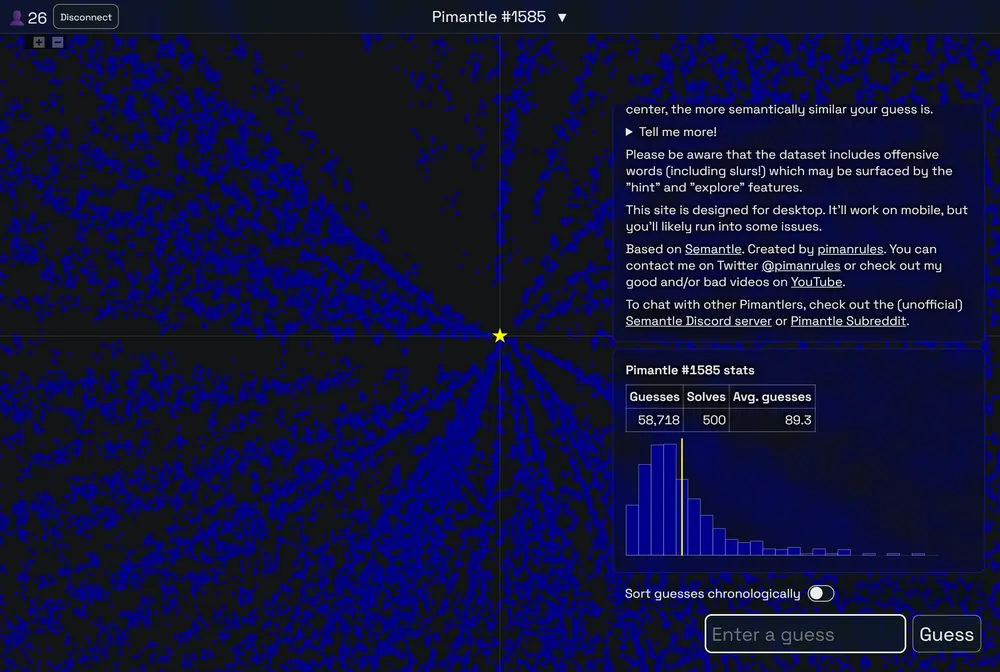
Pimantle is a daily word game where you hunt one secret word a day by meaning, not spelling, scoring each guess by how semantically close it is to the answer. It is built on the same word2vec idea as Semantle, but adds a signature radial visualization that maps your guesses by similarity and arranges related words into visible groups. With unlimited guesses, it is a patient, exploratory puzzle rather than a timed challenge.
What is Pimantle?
Pimantle is a daily semantic word game: every day a single secret word is chosen, and your job is to discover it by guessing other words and reading how close in meaning they are. Instead of matching letters, the game compares the meaning of your guess to the meaning of the answer using a word2vec language model, the same machine-learning approach that powers Semantle. Each guess earns a cosine-similarity score, where a higher number means your word lives nearer the secret word in meaning. For the radial plot the radius is this cosine value, which mathematically runs from about -1 to 1, though the on-screen figure for very distant words can occasionally read slightly outside that band. Because there is no spelling component and no guess limit, a session is less a sprint and more a slow triangulation toward a hidden target.
What sets Pimantle apart from both Wordle and plain Semantle is its visualization. Pimantle plots your guesses on a radial map with the target at the center: the distance from the middle reflects how similar a word is to the answer, while the angle around the circle comes from a one-dimensional projection of the word list. Points are pulled gently toward their closest relatives, so the scatter forms swirling, arm-like groupings rather than an even spread. The practical payoff is that you can see which themes are forming. When several related words drift toward the center together, the picture tells you which region of meaning is worth digging into, which makes the otherwise abstract hunt a little easier to read.
Pimantle is a spin-off of Semantle, the meaning-based guessing game built by David Turner in early 2022 during the Wordle boom. Pimantle itself was made by the creator known as pimanrules, whose code lives under the handle jsettlem, and it is hosted at semantle.pimanrul.es, layering its grouped point cloud on top of the familiar Semantle scoring. It inherits Semantle's reputation for difficulty: because the connections are semantic rather than visual, a word can score surprisingly high or low for reasons that only make sense once you find the answer. That open-endedness is part of the appeal for the people who like it.
The feedback loop is simple to read once you start. After each word you submit, you get its similarity score, and if your guess ranks among the words closest to the secret one, the game also shows a rank that tells you just how warm you are. There is no penalty for guessing often, so experimenting widely is the normal way to play. Pimantle suits patient solvers, word lovers, and anyone who enjoys a puzzle that rewards lateral thinking over speed. If you miss a day or want more practice, the site keeps an archive so you can go back and play earlier puzzles too.
How to play Pimantle
- Open Pimantle and type any real word as your first guess at the day's secret word.
- Read the similarity score it returns, where a higher number means your word is closer in meaning to the answer.
- If your guess is among the nearest words to the secret word, note the rank it shows to gauge exactly how warm you are.
- Find your new guess on the radial map: words closer in meaning sit nearer the center, and related words appear grouped together.
- Steer toward the hottest group by guessing synonyms, categories, and closely related concepts of your warmest words.
- Keep guessing without limit, refining as scores climb, until you land on the exact secret word.
Tips and strategy
- Treat the score scale seriously: small jumps near the low end mean little, but a sudden climb signals you are entering the right theme, so chase that direction hard.
- When a guess ranks among the nearest words, mine it aggressively with its synonyms, antonyms, and category siblings, since the answer is usually a short semantic hop away.
- Read the map for groups, not single points: if three or four related words all pull toward the center, the answer likely sits inside that group's meaning.
- Vary your parts of speech, because the secret word might be a verb, noun, or adjective, and a warm noun does not rule out a warmer related verb.
- Test broad category words early (animal, emotion, tool, color) to find which conceptual region scores best before drilling into specifics.
- Watch for false friends: a word can score high for an unexpected sense, so when a guess feels off-theme but warm, explore that alternate meaning instead of ignoring it.
Good to know
- Resets
- Daily, a new secret word each day
- Cost
- Free to play in a web browser
- Guesses
- Unlimited
- Archive
- Yes, past puzzles are playable via the Archive option
- Creator
- pimanrules (jsettlem), at semantle.pimanrul.es
- Based on
- Semantle by David Turner, using word2vec similarity
Pimantle FAQ
Is Pimantle free?
Yes. Pimantle is free to play in a web browser at semantle.pimanrul.es, with no download or account required.
How many guesses do you get in Pimantle?
Unlimited. There is no guess cap, so the challenge is finding the secret word by meaning rather than racing a limited number of tries.
Is there a Pimantle archive?
Yes. The site offers an Archive option so you can go back and play earlier daily puzzles if you missed a day or want extra practice.
Is Pimantle related to Wordle?
Only loosely. Both are daily word games, but Wordle is about spelling and letter placement, while Pimantle is built on Semantle and judges guesses by meaning using a word2vec model.
What is the difference between Pimantle and Semantle?
Pimantle uses the same meaning-based scoring as Semantle but adds a radial visualization that plots your guesses by similarity and arranges related words into visible groups around the target.