Polygonle
Guess the word from its shape pattern.
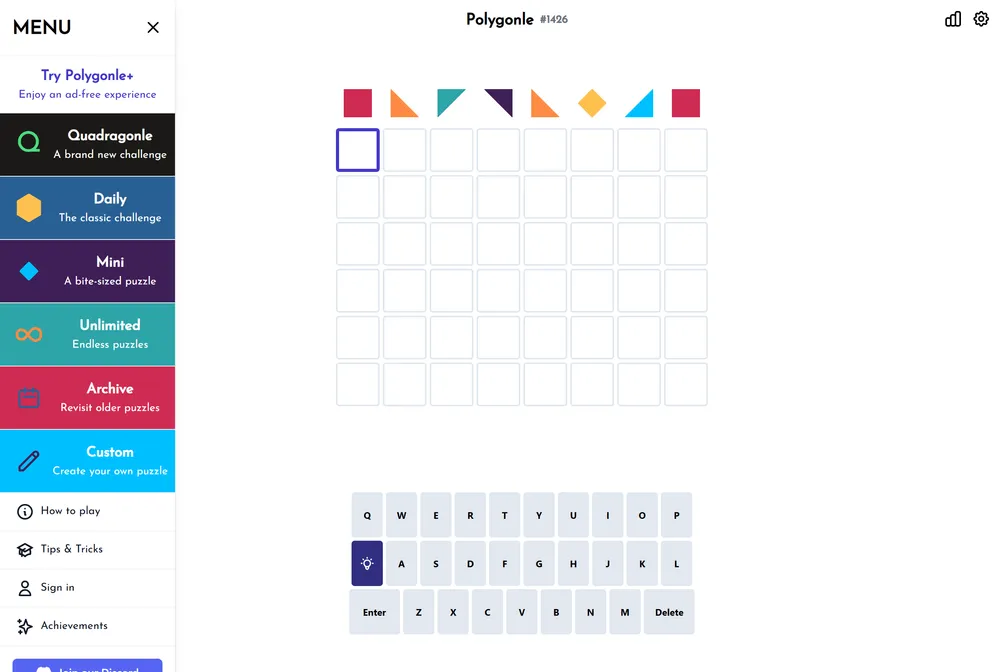
Polygonle swaps Wordle's empty boxes for a row of polygons, where each shape represents one letter of a hidden word and matching shapes always mean matching letters. The answer changes length from day to day, running six to eight letters, and it always includes at least one repeated letter, so the shape row is your opening clue and always shows a repeat to decode. You have six tries, and the same green, yellow, and gray feedback you know from Wordle does the rest.
What is Polygonle?
Polygonle is a daily browser word game built around a single clever twist: before you type anything, you are shown a row of geometric shapes, and each shape stands in for one letter of the hidden answer. Wherever a shape repeats, that letter repeats, so a pattern of two identical triangles tells you the same letter sits in both of those positions. The daily answer is always between six and eight letters long, and by design it always includes at least one set of repeated letters, which means the shape row always shows at least one repeated polygon. Because the answer length changes from one day to the next, that shape pattern is the very first piece of information you work with, and it often narrows the field of possible words long before any colors appear.
What sets Polygonle apart from the wave of Wordle variants is that the shape pattern is a real constraint rather than decoration. In standard play you can guess any valid word of the right length, but the repeated-shape structure rewards players who reason about letter skeletons instead of just spraying common letters. The game leans into this with an Expert Mode, where every guess you submit must itself match the shown shape pattern. That sounds like a small rule, but it can make certain puzzles dramatically harder, since you are forced to find real words that share the exact repeat structure of the answer rather than using throwaway probing words.
Polygonle was created by Grant Warman, a software engineer who goes by the handle blorppppp. By his own account it is the first game he built. The idea traces back to a cryptographic shape-to-letter puzzle that circulated in a Super Smash Bros. Melee Discord community in Colorado; after seeing how much people enjoyed decoding those patterns, he wrote tools to generate them and turned the concept into a daily game. It grew largely through word-game creators on TikTok and has since drawn over a million players from many countries. The site stayed ad-free for roughly its first nine months before introducing an optional ad-free upgrade alongside the free, ad-supported version.
Scoring follows the familiar colored-tile convention: green means a correct letter in the correct spot, yellow means the letter is in the word but somewhere else, and gray means the letter is not in the answer at all. You get six tries, and at the end the game produces a spoiler-free grid of colored squares you can copy and share so friends can compare how quickly they cracked the same pattern. Beyond the daily puzzle the site offers extra modes, including unlimited play and an archive of past puzzles, so newcomers are not limited to a single board a day. The overall vibe is brisk and brainy: friendlier than a cryptic crossword but more demanding than plain Wordle, and a good fit for anyone who likes the daily-puzzle ritual but wants a structural clue to chew on first.
How to play Polygonle
- Look at the row of polygons first and count them: the number of shapes equals the number of letters in today's answer, which is always between six and eight.
- Note where shapes repeat, since identical polygons mark positions that hold the same letter and different polygons mark different letters. There is always at least one repeated shape to find.
- Type any real word of the matching length as your opening guess to start gathering color feedback.
- Read the tile colors: green is a correct letter in the right spot, yellow is a correct letter in the wrong spot, and gray means the letter is not in the word.
- Combine the shape pattern with the colors to narrow down which letter each polygon represents, then refine your next guess.
- Solve the word within six tries, and for an extra challenge try Expert Mode, where every guess must itself fit the shape pattern.
Tips and strategy
- Decode the shape skeleton before typing: brainstorm words whose repeated-letter pattern matches the repeated polygons, since that alone can eliminate most candidates.
- Because every answer has at least one repeated shape, test a common doubled letter in those exact slots early, as confirming the repeated letter locks down a big part of the word.
- Use your first guess to cover frequent vowels and consonants that fit the pattern length, rather than wasting it on rare letters.
- Pay attention to single, non-repeating shapes, because they often hide the trickier or less common letters that decide the puzzle.
- Treat yellow tiles as position clues against the shape map: a yellow letter must move to a slot whose polygon does not contradict the colors you already have.
- If you want a real workout, switch to Expert Mode, but plan for many more guesses since every entry has to match the answer's repeat structure.
Good to know
- Resets
- Daily, at local midnight
- Guesses
- 6 tries
- Word length
- 6 to 8 letters, always with at least one repeated letter
- Cost
- Free to play in the browser, with an optional ad-free upgrade
- Creator
- Grant Warman (handle blorppppp)
- Modes
- Daily, Expert, and additional modes including unlimited play, plus a past-puzzle archive
Polygonle FAQ
Is Polygonle free?
Yes. Polygonle plays free in your web browser with no account or download required. It is ad-supported, and the site also offers an optional paid upgrade to remove ads.
How many guesses do you get in Polygonle?
You get six guesses to find the hidden word, the same as Wordle. In Expert Mode you still get attempts, but every guess must match the shown shape pattern, which can make a puzzle take far more tries.
When does Polygonle reset?
A new daily puzzle is released every day at midnight in your local time zone, so the board you see refreshes once per day.
How long are Polygonle answers?
Every daily answer is between six and eight letters long, and it always contains at least one repeated letter, which is why the shape row always shows at least one repeated polygon.
Is Polygonle related to Wordle?
It is inspired by Wordle and uses the same six-guess format and green, yellow, and gray feedback, but it is an independent game created by Grant Warman. Its defining difference is the row of polygons that reveal which positions share the same letter before you guess.