Antiwordle
Try to avoid guessing the secret word.
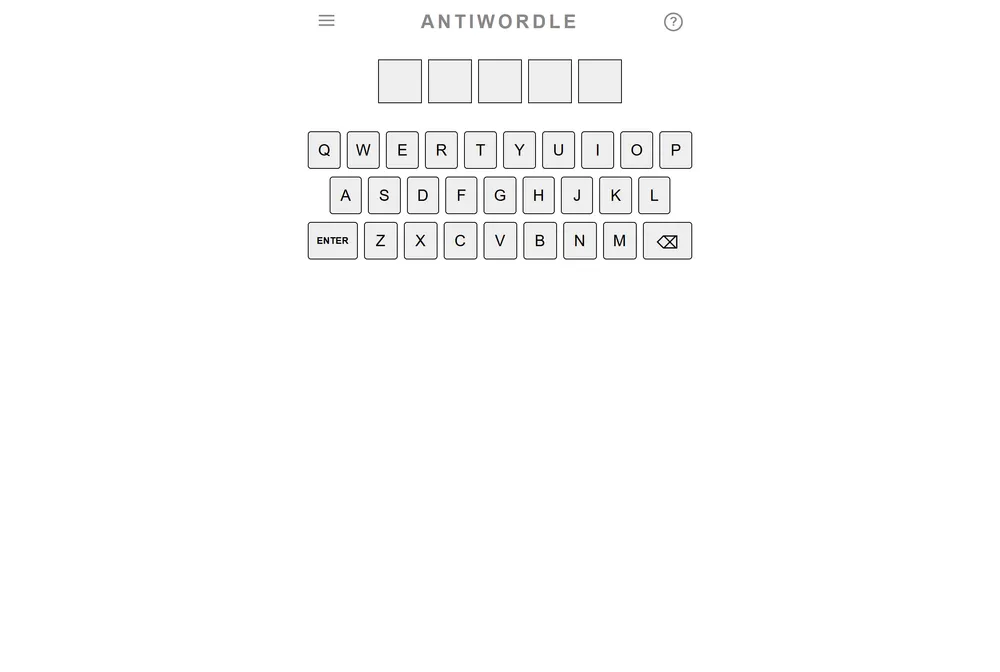
Antiwordle hands you a Wordle grid and one stubborn instruction: do not guess the secret word. Every clue you reveal turns into a rule you must obey for the rest of the round, so each correct letter makes the next safe guess harder to build. The longer you avoid the answer, the higher you score.
What is Antiwordle?
Antiwordle is a browser word puzzle that takes the familiar five-letter Wordle grid and reverses its purpose. Instead of racing to find the hidden word, you are trying to dodge it. The trick is that every clue you reveal becomes a binding rule for the rest of the round, so the game slowly tightens around you until you have no choice but to spell the answer. Your score is the number of guesses you survived before that happens, which means a long, awkward, sprawling game is a good game.
What sets Antiwordle apart from other Wordle variants is that its feedback works against you rather than for you. In standard Wordle, color clues narrow your search and help you close in. Here the same colors act as constraints you are forced to carry forward. A grey letter is removed from play and cannot appear in any later guess, which is the one outcome you want, since it costs you nothing and shrinks the danger. A yellow letter, by contrast, is confirmed to be in the word, and once it turns yellow you must include it in every guess that follows. A red letter is worse still: it is sitting in its correct slot and locks there permanently, so you are stuck building around a position you already got right. The cruel logic is that every accurate guess makes your next safe guess harder to construct.
Antiwordle offers one shared puzzle per day, and the hidden answer is the same for everyone playing on a given date, so you and every other player worldwide are working against the identical word. There is no six-guess cap as in Wordle; you take as many attempts as you can manage, and stretching that count is the entire point. When you finally land on the full word the round ends and the game presents your result, which players commonly capture and share. The official site does not appear to include a built-in calendar archive of past words, so once a new day's puzzle goes live the previous answer is generally gone unless a fan site has logged it.
The vibe is playful and a little contrarian, and the difficulty curve is unusual because it runs in the opposite direction from most games: easy at the start when almost anything is fair, then increasingly cramped as forced yellows and locked reds pile up. It rewards people who enjoy deliberately bad play, vocabulary breadth, and thinking several moves ahead about which letters are still safe. Players who already burned through their daily Wordle and want a quick, free, low-stakes twist tend to be the core audience, along with anyone who likes the idea of losing on purpose as skillfully as possible. The creator and publisher behind antiwordle.com are not publicly documented, so it is best understood as one of the many independent Wordle spinoffs that appeared after Wordle went viral.
How to play Antiwordle
- Type any valid five-letter word as your opening guess to start probing the board.
- Watch the colors: grey means the letter is absent and is removed from play so you cannot use it again, which is the safe outcome you want.
- A yellow letter is in the word but misplaced, and from now on you are required to include it in every guess.
- A red letter is in its exact correct spot and locks there permanently, forcing you to keep it in place for the rest of the game.
- Keep entering words that satisfy all your forced yellow and red letters while still trying not to complete the hidden answer.
- The round ends the moment you are cornered into spelling the full secret word, and your final guess count is your score, so aim for as many guesses as possible.
Tips and strategy
- Open with words packed with uncommon letters such as J, Q, X, Z, V, and W, since turning them grey safely clears them off the board with no risk.
- Treat grey results as wins and yellow or red results as setbacks, because greys cost you nothing while colored letters add permanent constraints.
- When a letter goes yellow, deliberately place it in positions you believe are wrong so it stays yellow instead of accidentally turning red and locking.
- Avoid guessing real, common five-letter words once several letters are confirmed, since plausible words are exactly where the hidden answer hides.
- Use doubled or repeated letters to fill mandatory yellow and red slots while still spelling something unlikely to be the target.
- Track which letters are still grey-eligible and steer toward those, because as safe letters run out your room to stall shrinks fast.
Good to know
- Resets
- Daily, one new word each day
- Cost
- Free to play in a web browser
- Guesses
- Unlimited; more guesses is a better score
- Goal
- Avoid the secret word for as long as possible
- Platform
- Browser, no download or account needed
- Archive
- No official archive of past daily words
Antiwordle FAQ
Is Antiwordle free?
Yes. Antiwordle plays for free in any web browser at antiwordle.com, with no download, sign-up, or account required.
How many guesses do you get in Antiwordle?
There is no fixed limit. Unlike Wordle's six tries, Antiwordle gives you unlimited guesses, and your score is simply how many you survived before being forced into the answer.
When does Antiwordle reset?
It uses a daily puzzle, so a new hidden word arrives each day. The answer is shared, meaning every player faces the same word on a given date until the next day's puzzle goes live.
Is there an Antiwordle archive?
The official site does not appear to offer a built-in calendar of past puzzles. Once a new day's word goes live, the previous one is generally gone unless a third-party fan site has recorded it.
Is Antiwordle related to Wordle?
It is an independent Wordle spinoff, not an official New York Times product. It borrows the five-letter grid and color feedback but inverts the goal so you try not to find the word.