Connections
Sort sixteen words into four hidden groups.
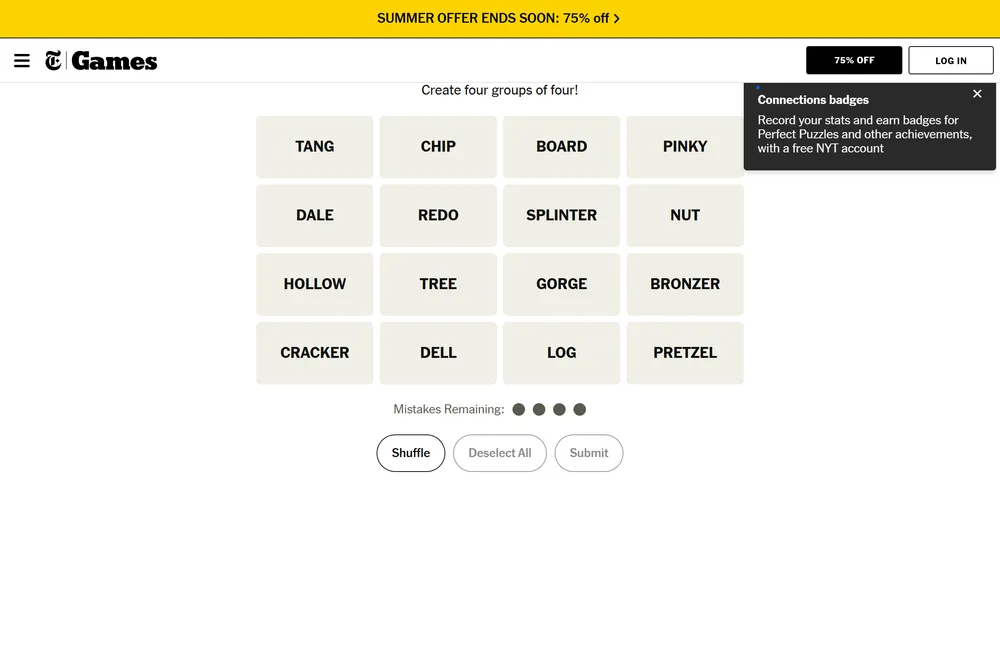
Connections is the New York Times grouping puzzle: sixteen words, four hidden categories of four, and a daily grid built to make you second-guess every move. The trick is the overlap, since many words look like they fit more than one group, and the four difficulty tiers run from gentle to genuinely sneaky. One puzzle a day, and you get just four wrong guesses to solve it.
What is Connections?
Connections drops a four-by-four grid of sixteen words into your lap and asks a deceptively simple question: which four belong together, and why? Under the surface sit four hidden categories, each binding exactly four of the words, and your job is to untangle all sixteen without tripping over the words that were placed there to mislead you. There is one new grid every day, and the satisfaction comes from the moment a stubborn cluster suddenly snaps into a clean theme.
What sets it apart from Wordle and the many five-letter clones is that it is a sorting puzzle rather than a spelling one. There is no hidden answer word and no green-letter feedback; instead the challenge is conceptual, built on associations, wordplay, and red herrings. Several words will plausibly fit two or three groups at once, and the puzzle is engineered so the obvious reading is often the wrong one. A word like a common noun might belong to a category of homophones, a set of compound-word halves, or a list of things that precede a shared word, and only by ruling out the other groups can you be sure where it lands.
Connections is made by The New York Times Games team and edited by Wyna Liu, who was assigned the puzzle after it came out of an internal game jam. It entered beta on June 12, 2023, and went on to become the second most played game the Times publishes, behind Wordle. The four categories are color coded by difficulty: yellow is the most straightforward, then green, then blue, with purple reserved for the trickiest grouping, which often leans on a pun or a sneaky pattern rather than a plain category. Each grid contains exactly one category at each of those four tiers.
When you finish, the game produces a shareable result as a grid of colored squares that shows the order in which you cracked the groups and where you slipped, without revealing the actual words or themes, so you can compare with friends without spoiling the puzzle. It also offers a shuffle button to rearrange the tiles when you are stuck and a deselect option to clear your current pick. The vibe is short, daily, and quietly competitive: a five to ten minute brain stretch that rewards lateral thinking and pattern recognition. It suits anyone who likes crosswords, trivia, and the specific thrill of spotting a connection nobody else saw, and the steady purple-group difficulty keeps even seasoned solvers honest.
How to play Connections
- Open the day's grid of sixteen words and read all of them before touching anything.
- Look for four words that share a single specific category, keeping in mind that some words are planted to fit several groups.
- Tap to select exactly four words, then submit your guess.
- If the group is correct it locks in and is revealed with its difficulty color; if not, the guess counts against you.
- Keep grouping until you sort all sixteen words, but stop reaching once you have used your four mistakes, since that ends the puzzle.
- Use shuffle to rearrange tiles for a fresh look and deselect to clear a pick you are unsure about.
Tips and strategy
- Start with the group you are most certain of and lock it in first, because every word you remove makes the remaining grid clearer.
- Treat the cleanest, most obvious-looking category with suspicion; if four words snap together too easily, the puzzle is often baiting you into a wrong group.
- Watch for words that could fit two themes and try to assign them last, after the safer words around them have committed elsewhere.
- Think beyond plain meaning: categories frequently hinge on homophones, hidden words, compound-word halves, or a word that comes before or after a shared term.
- Aim to identify the purple group, since it is the hardest tier and pinning it down often forces the other three into place by elimination.
- If you are stuck, hit shuffle to break the visual grouping your eyes have settled into, which can surface a connection you were overlooking.
Good to know
- Resets
- Daily, around midnight (your local time)
- Cost
- Free to play
- Mistakes allowed
- Four
- Grid
- 16 words, four hidden groups of four
- Creator / Publisher
- Edited by Wyna Liu, The New York Times Games
- Platforms
- Web browser, iOS, and Android
Connections FAQ
Is Connections free?
Yes. The daily Connections puzzle is free to play in a web browser and in the New York Times Games app on iOS and Android.
How many guesses do you get in Connections?
You can make four mistakes. Each incorrect group of four counts as one mistake, and using all four ends the puzzle before you solve it.
When does Connections reset?
A fresh grid is released once per day, rolling over around midnight in your local time, so there is a new puzzle waiting each morning.
Is there a Connections archive?
The Times offers an archive of past Connections puzzles as part of its Games subscription, and several independent fan sites also host previous grids to replay for free.
Is Connections related to Wordle?
Both are daily puzzles from The New York Times, but Connections is a word-grouping game rather than a guess-the-word game, and it is the second most played title the Times publishes after Wordle.