Word Peaks
Guess the word using alphabetical hints.
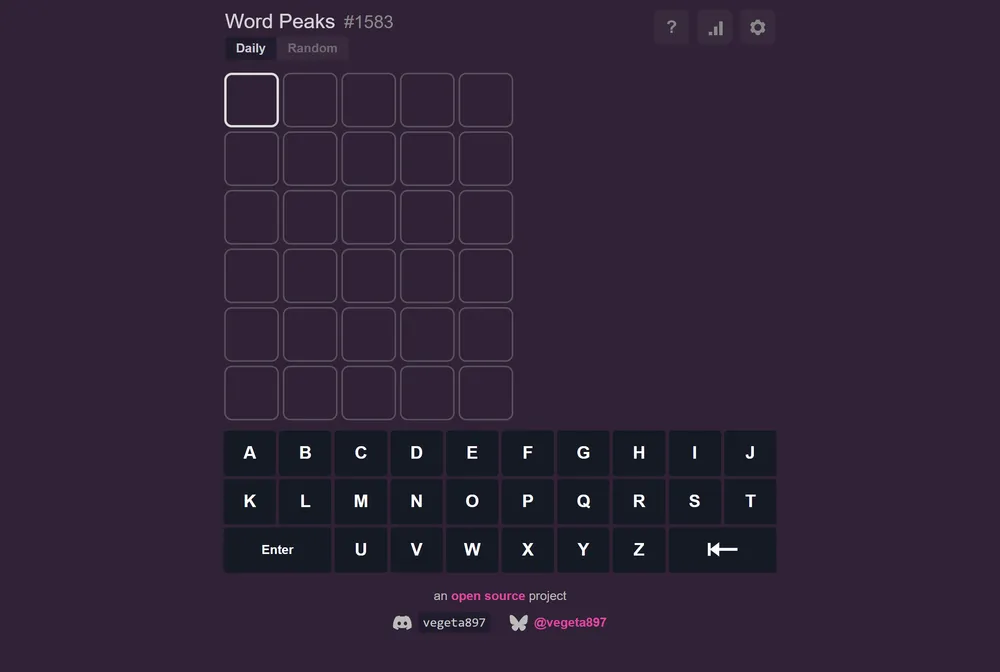
Word Peaks gives you a hidden five-letter word and six guesses, but instead of telling you which letters belong, it tells you which way to move through the alphabet. Every tile after a guess shows whether the true letter sits earlier or later than the one you typed, so you binary-search each position toward the answer. It is a free, daily browser puzzle with a fresh word for everyone each day.
What is Word Peaks?
Word Peaks is a daily browser word game built around a single clever twist on the Wordle formula: instead of telling you which of your letters belong in the word, it tells you where each correct letter sits in the alphabet relative to the one you typed. A hidden five-letter word waits behind six rows of empty tiles, and your job is to home in on it by reading alphabetical direction rather than letter presence. Because the feedback points you higher or lower for every single position, the game plays less like a vocabulary test and more like five simultaneous guessing games, one per tile.
The mechanic is what sets it apart from the crowd of Wordle clones. In standard Wordle you learn whether a letter is in the word and whether it is placed correctly, which rewards knowing common letters and patterns. Word Peaks throws that out. Every tile is either green for an exact match, orange to say the true letter falls later in the alphabet than your guess, or blue to say it falls earlier. There is no yellow, no concept of a letter being right but misplaced, because the feedback is purely directional. That makes the solving process feel like a binary search: each clue cleanly cuts the range of possible letters for that slot, and a careful player can corner the answer through logic even with a fairly ordinary vocabulary.
The game is the work of Devin Spikowski, who publishes under the handle vegeta897 and works as an IT consultant outside of his creative projects. He has said he came up with the idea in 2022 while playing Wordle, realizing that every letter in a guess is simply before or after the target letter, and he prototyped and coded the whole thing in a single day. It is an open source project released under the MIT license and built with SvelteKit, so the code is public on GitHub and the community has contributed crowdsourced translations. One signature flourish appeared after launch: each set of guesses quietly builds a small procedurally generated landscape of hills and peaks, which is where the name comes from and which gives every solved puzzle its own little scene.
After you finish, Word Peaks produces a spoiler-free emoji grid you can copy and share, using its own colored squares so friends see your path without learning the word. Beyond the once-a-day puzzle that everyone solves together, there is a random or practice mode for unlimited play, an optional on-tile range display that shows the surviving letter window for each position, and accessibility touches like multiple languages and a dyslexia-friendly font. The vibe is calm, minimal, and logic-forward rather than flashy, and the difficulty leans thoughtful: it suits people who enjoy deduction puzzles, anyone burned out on guessing common letters, and players who like the daily-ritual rhythm of a fresh word each day.
How to play Word Peaks
- Type any valid five-letter word and submit it as your opening guess.
- Read each tile: green means that letter is exactly correct in that spot.
- An orange tile means the target letter for that position comes later in the alphabet than the one you guessed.
- A blue tile means the target letter comes earlier in the alphabet than the one you guessed.
- Use the direction on every tile to shrink the range of possible letters for each of the five positions, optionally turning on the range display to track the surviving window.
- Keep refining your guesses and solve the word within six tries, then copy the emoji grid to share your result.
Tips and strategy
- Treat each position like a number line: open with letters near the middle of the alphabet (around M or N) so the first orange or blue clue cuts the possibilities roughly in half.
- Because there is no yellow, a letter being in the word does not matter here, so do not save letters across positions the way you would in Wordle; instead spend each guess probing the widest open ranges.
- Enable the on-tile range display so you can see the exact surviving letter window for every position and avoid wasting a guess on a letter you have already ruled out.
- When a tile shows green, lock that slot and pour your remaining guesses into the positions that still have the largest alphabetical gaps.
- If two positions are narrowed to just a few letters each, pick a real word that tests both uncertain slots at once rather than confirming one at a time.
- Use the random or practice mode to rehearse the binary-search habit, since the directional feedback rewards deliberate range-splitting far more than guessing familiar words.
Good to know
- Resets
- New daily word once per day; a random/practice mode allows unlimited extra rounds
- Cost
- Free, with no ads
- Guesses
- 6 attempts for a 5-letter word
- Creator
- Devin Spikowski (vegeta897), first built in 2022
- Platform
- Browser, open source (MIT license), built with SvelteKit
- Languages
- English plus crowdsourced translations including French, Dutch, Spanish, Brazilian Portuguese, Turkish, German, and Polish; OpenDyslexic font available
Word Peaks FAQ
Is Word Peaks free?
Yes. Word Peaks is a free browser game with no ads, and it is open source under the MIT license, so the full code is public on GitHub.
How many guesses do you get in Word Peaks?
You get six guesses to find the hidden five-letter word, the same number as Wordle.
How is Word Peaks different from Wordle?
Word Peaks does not tell you whether a letter is in the word. Instead each tile shows green for an exact match, orange if the true letter is later in the alphabet than your guess, or blue if it is earlier, so you narrow each position by alphabetical direction rather than by letter presence.
Is there a practice mode in Word Peaks?
Yes. Alongside the once-a-day puzzle that everyone shares, there is a random or practice mode you can play as many times as you like to rehearse the directional solving approach.
Who made Word Peaks?
It was created by Devin Spikowski, who goes by vegeta897 online. He thought of the idea in 2022 while playing Wordle and prototyped the game in a single day.
What are the colored hills in Word Peaks?
Each set of guesses builds a small procedurally generated landscape of hills and peaks, a visual flourish the creator added after launch that also inspired the game's name.