Soulsborndle
Guess the daily FromSoftware boss from attribute hints.
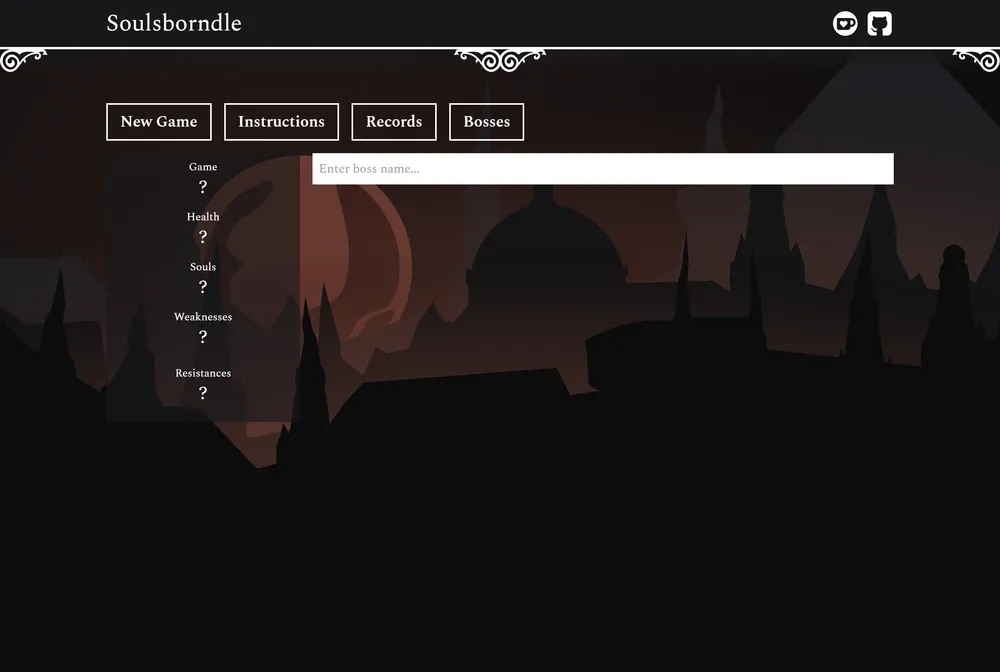
Soulsborndle is a Wordle-style guessing game built around FromSoftware bosses, where you name bosses you know and read color-coded clues to deduce a hidden one. Each new game picks a random boss from the Demon's Souls, Dark Souls, Bloodborne, and Elden Ring catalog, and you narrow it down using feedback on attributes like the game it belongs to, its health and souls values, and its elemental resistances and weaknesses.
What is Soulsborndle?
Soulsborndle is a browser-based deduction game that crosses the structure of Wordle with the bestiary of FromSoftware's action role-playing games. Instead of letters, you guess bosses, and instead of a five-letter word, the hidden answer is a single boss pulled from the Soulsborne catalog. Each new game selects a random boss for you to identify, and you work toward it by typing in bosses you know and reading the feedback your guesses generate. There is no fixed word of the day here: you can start a fresh game whenever you want and keep playing as long as you like.
What sets Soulsborndle apart from a plain Wordle clone is how much information each guess carries. When you submit a boss, the board compares it to the answer across several attributes at once, including which game the boss comes from and other identifying traits such as the kind of enemy it is and where you encounter it. Color-coded cells mark each attribute, with green for a match, yellow for a partial or related match, and red for a miss. Alongside those columns, an info panel tracks the answer's health pool and souls value as numeric ranges, using directional arrows to tell you whether the true figure is higher or lower than your last guess. Confirmed resistances and weaknesses across damage types such as Magic, Fire, Lightning, Dark, Holy, Physical, Slash, Strike, and Thrust surface as you go, giving you elemental angles to narrow the field.
The game is the work of malthesers and is built as an open-source web app using Vue, TypeScript, and Tailwind CSS, with its full source published on GitHub. It has grown across several releases since its first version: later updates added a game-selection feature, fuzzy name searching so you do not have to spell unusual boss names perfectly, and a batch of bosses from the Elden Ring expansion Shadow of the Erdtree. A built-in records system keeps your top ten personal-best runs, listing the boss you tracked down and how many guesses it took, so you can chase tighter solves over time.
The pool you draw from is yours to set. Through a bosses modal you can include or exclude Demon's Souls, the three Dark Souls entries, Bloodborne, and Elden Ring in any combination, which lets you tune the difficulty and lean into whichever titles you know best. The vibe rewards genuine series knowledge: someone who remembers roughly how much health a boss has, what it is weak to, and which game it belongs to will close in quickly, while a casual player can still triangulate using the ranges and color clues alone. It is a comfortable fit for FromSoftware fans who enjoy testing their lore recall and for anyone who likes logic puzzles with a clear, readable feedback loop.
How to play Soulsborndle
- Start a new game, which selects a random boss for you to identify from the games you have enabled.
- Type the name of any boss you know to make your first guess; fuzzy search helps if a name is spelled oddly.
- Read the color-coded row, where green marks an attribute that matches the answer, yellow a partial match, and red a miss.
- Watch the info panel for the health and souls ranges, where arrows tell you whether the true value is higher or lower than your guess.
- Note any resistances and weaknesses that get confirmed, then pick a next boss that fits all the clues you have gathered.
- Keep guessing until you name the correct boss, then check your records to see if you set a new personal best.
Tips and strategy
- Lock in the source game early, since matching the right title eliminates more candidates than almost any single other clue.
- Treat the health and souls ranges like a number line and guess bosses that push those brackets tighter from both ends.
- Once a weakness or resistance is confirmed, favor bosses known for that elemental profile to cut the list fast.
- Pay attention to every attribute the board reveals, not just the game, so each guess earns its place.
- Narrow the pool in the bosses modal to the games you know best when you want cleaner, faster solves.
- If a name is hard to spell, lean on the fuzzy search and type a close approximation rather than abandoning a good guess.
Good to know
- Type
- FromSoftware boss guessing game
- Mode
- Unlimited, random boss each new game
- Games covered
- Demon's Souls, Dark Souls 1-3, Bloodborne, Elden Ring
- Cost
- Free to play in a browser
- Creator
- malthesers (open source on GitHub)
- Records
- Stores your top 10 personal-best runs
- Tech
- Vue, TypeScript, Tailwind CSS web app
Soulsborndle FAQ
Is Soulsborndle free?
Yes. Soulsborndle is a free web game that runs in your browser with no purchase or account required, and its source code is openly available on GitHub.
Is Soulsborndle a daily game?
No. Unlike many -dle games, Soulsborndle does not lock you to one puzzle a day. Each new game picks a random boss, so you can start fresh and play as many rounds as you want.
Which games do the bosses come from?
Bosses are drawn from Demon's Souls, Dark Souls, Dark Souls II, Dark Souls III, Bloodborne, and Elden Ring, including bosses added from the Shadow of the Erdtree expansion. You can choose which of these to include.
How is Soulsborndle related to Wordle?
It borrows Wordle's guess-and-feedback loop but swaps words for FromSoftware bosses. Color-coded clues mark how each guess compares to the answer across attributes such as the game it belongs to, its health and souls values, and its resistances and weaknesses.
Is there a Soulsborndle archive?
There is no archive of past puzzles, since the game is not date-based. It does keep a records list of your top 10 best runs, showing the boss you solved and how many attempts it took.