Riffdle
Guess the song by learning its riff.
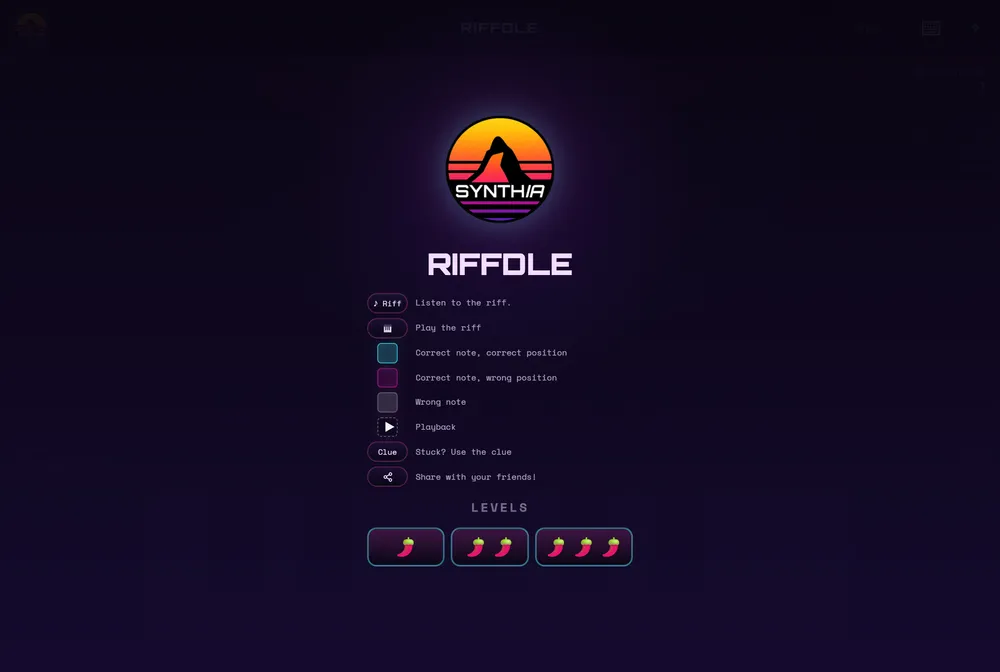
Riffdle is a daily music puzzle that turns the familiar -dle format into an ear-training challenge: instead of guessing a word, you rebuild a song's riff note by note on a piano keyboard. You listen to a hidden riff, play your best guess, and use color-coded feedback on each note to close in on the answer. Built at Synthia.space, it rewards a good ear and a little keyboard curiosity rather than knowing song titles.
What is Riffdle?
Riffdle is a music puzzle that asks you to identify a piece of music by its riff, the short repeated melodic phrase that makes a song instantly recognizable. You start by listening to a hidden riff, then recreate it note by note on an on-screen piano keyboard. After each attempt the game colors your notes with Wordle-style feedback so you can tell which pitches were right and where they sat in the sequence. The core daily ritual is the same for everyone: one riff, a fixed playable keyboard, and the goal of rebuilding the phrase before your attempts run out.
What sets Riffdle apart from the broader -dle field is that it is played with your ears and hands rather than with letters. Word games like Wordle reward vocabulary and elimination logic, and audio guessing games like Heardle reward catalog knowledge, but Riffdle asks you to actually reproduce a melody. You are not typing a song title; you are pressing keys until the notes and their order match the target. That makes it part ear-training exercise and part puzzle, and it tends to reward people who can hum a tune and find it on a keyboard more than people who simply know a lot of song names.
Riffdle was built at Synthia.space, a small synthwave-themed music platform whose stated mission is to help more people play, learn, and rediscover the joy of making music. The game is credited to Fabio J. Fehr, Karl El Hajal, and Laurent Colbois, and it sits alongside other Synthia tools such as a virtual keyboard and a radio jukebox. The retro arcade styling, the spice-pepper difficulty markers, and the focus on real riffs all reflect that music-first, hobbyist origin rather than a large commercial publisher.
The feedback system is the heart of the experience. Each guessed note is graded three ways: correct note in the correct position, correct note in the wrong position, and wrong note, which lets you triangulate the riff over successive tries. Difficulty is signaled with chili-pepper levels from mild to very hot, and a clue plus a replay of the riff are there for when you stall. When you finish you can share your result with friends, keeping the social, one-puzzle-a-day feel that makes the -dle format so easy to pass around. The vibe is relaxed and a little nostalgic, friendly to curious beginners while still satisfying for musicians who want to test their ear.
How to play Riffdle
- Open Riffdle in your browser at synthia.space/riffdle.
- Press play to listen to the day's hidden riff, and replay it as many times as you need to hear the melody.
- Use the on-screen piano keyboard to enter the notes of the riff in the order you think they occur.
- Submit your attempt and read the feedback: each note is marked as correct note and position, correct note but wrong position, or wrong note.
- Adjust your next guess based on that feedback, moving misplaced notes and replacing wrong ones until the riff matches.
- If you stall, replay the riff or use the clue, then share your result with friends once you solve it.
Tips and strategy
- Listen to the riff several times before touching the keyboard, and try to hum it first so you have the shape of the melody in your head.
- Lock in the first note early. Once you have a confirmed correct note and position, you have an anchor to build the rest of the phrase around.
- Treat correct note, wrong position hints as gold: that pitch belongs in the riff, so try sliding it to a different spot rather than abandoning it.
- Pay attention to whether the melody rises or falls between notes, and use that contour to choose nearby keys instead of guessing randomly across the keyboard.
- Spend your clue and replays wisely on the higher spice levels, where the riffs are longer or trickier and a single extra listen can save several attempts.
- If you are new, start on the milder pepper difficulty to learn how the note feedback behaves before taking on the very hot riffs.
Good to know
- Category
- Music / riff recreation puzzle
- Cost
- Free to play
- Creators
- Fabio J. Fehr, Karl El Hajal, and Laurent Colbois
- Publisher
- Synthia.space
- Feedback
- Correct note and position, correct note wrong position, or wrong note
- Platform
- Browser, plays at synthia.space/riffdle
Riffdle FAQ
Is Riffdle free?
Yes. Riffdle is free to play in your browser at synthia.space/riffdle, with no download or account required to start a puzzle.
How do you play Riffdle?
You listen to a hidden riff, then recreate it on an on-screen piano keyboard. After each attempt the game tells you which notes were correct and whether they were in the right position, so you can refine your next guess.
Is Riffdle like Wordle?
It borrows Wordle's color-coded feedback idea, but instead of letters you work with musical notes. You rebuild a riff on a keyboard, getting hints for right note and right position, right note but wrong position, or wrong note.
Who made Riffdle?
Riffdle was built at Synthia.space and is credited to Fabio J. Fehr, Karl El Hajal, and Laurent Colbois, a small team focused on helping more people play and learn music.
Can I get help if I am stuck in Riffdle?
Yes. Riffdle lets you replay the riff and use a clue when you are stuck, and you can share your result with friends after you finish.