Murdle
Solve a daily murder-mystery logic puzzle.
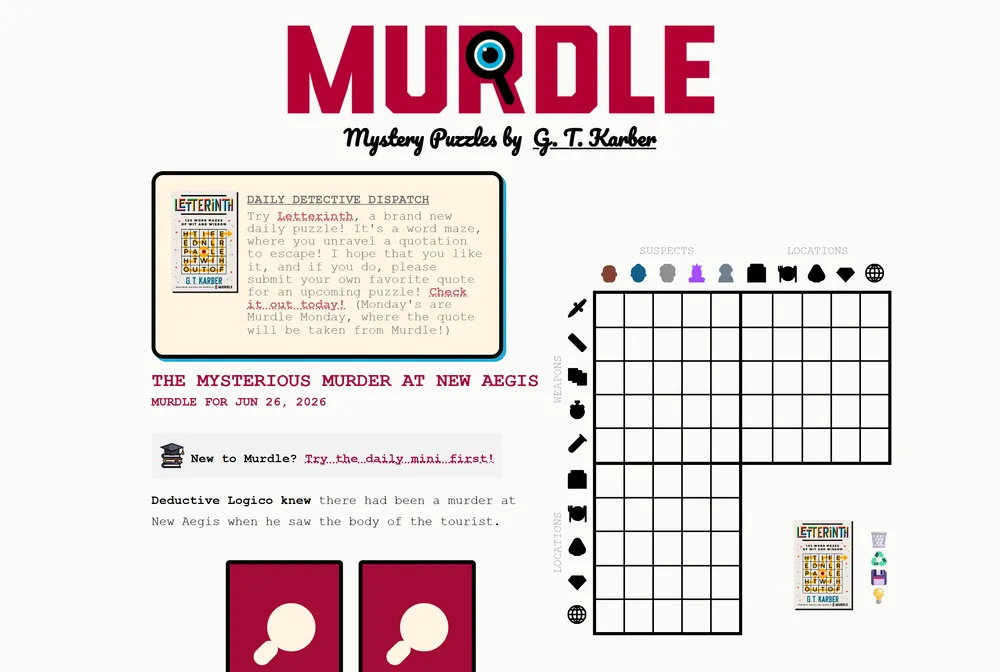
Murdle is a free daily whodunit that you crack with deduction, not guesswork. Each case hands you a cast of suspects, a set of weapons, a list of locations, and numbered clues, and asks you to name exactly who did it, how, where, and sometimes why. Created by G. T. Karber in 2022, it serves one fresh logic-grid mystery every day, growing trickier as the week goes on.
What is Murdle?
Murdle is a daily murder mystery that you solve with logic instead of luck. Every day the site presents a fresh case built around four questions: WHO committed the murder, HOW they did it, WHERE it happened, and WHY (the motive), depending on the difficulty. You are handed a cast of suspects, a set of murder weapons, a list of locations, and a stack of numbered clues, and your job is to work out the single arrangement of facts that all the clues allow.
What sets Murdle apart from most Wordle-style games is that there is no hidden answer to guess at and no limited number of attempts in the usual sense. Instead you reason your way to certainty using a deduction grid, the same kind of cross-referencing chart found in classic logic puzzles. You mark each suspect-weapon-location pairing as either ruled out or confirmed, and because every clue is a hard fact, careful elimination eventually leaves exactly one solution standing. The puzzles are also written with personality: a detective named Deductive Logico investigates each case, and Inspector Irratino, his esoteric and unconventional partner, is the one who supplies the hint when you ask for help. A rotating gallery of suspects gives each case a small story rather than a sterile grid.
Murdle was created by G. T. Karber and launched in 2022, openly inspired by the daily-puzzle format that Wordle made popular. It grew quickly into a best-selling franchise: the puzzles spawned a series of physical Murdle books of elementary-to-impossible mysteries, live murder-mystery events, and spin-off games. On the website the difficulty climbs through the week, with Monday cases being the gentlest and Saturday the hardest. Sunday is a special longer puzzle that gathers the previous six days' murderers together and weaves in a larger conspiracy, which is why the page sometimes warns that Sunday's case takes longer to generate.
When you are confident, you submit your accusation by naming the suspect, weapon, location, and motive. Get it right and the culprit is hauled off to jail; get it wrong and the game lets you know your reasoning broke down somewhere. A hint button is available if you get stuck, so you can choose between a clean unaided solve or a nudge in the right direction from Inspector Irratino. The overall vibe is cozy-noir and brain-teasing rather than tense, which makes it a good fit for logic-puzzle fans, mystery readers, and anyone who likes a single satisfying daily challenge they can finish in a sitting.
How to play Murdle
- Read the case briefing to learn the suspects, the possible murder weapons, the locations, and any motives that are in play for the day.
- Open the deduction grid, which lays out every suspect against every weapon and location so you can track what is possible and what is not.
- Work through the numbered clues in order, treating each one as a hard fact you can act on rather than a hint to weigh.
- Mark each grid cell as ruled out or confirmed, then cross-reference clues so one elimination forces the next until only one consistent answer remains.
- Use the hint button if you get genuinely stuck, since Inspector Irratino can point you toward a clue you have not fully used yet.
- Submit your accusation by naming the murderer, the weapon, the location, and the motive if required, then check whether the culprit goes to jail.
Tips and strategy
- Always record your eliminations, not just your matches, because a single ruled-out cell often cascades into several forced answers across the grid.
- Treat every clue as literally true and absolute; Murdle clues never bluff, so any combination a clue forbids can be crossed off with full confidence.
- Re-read the earlier clues after each round of marking, since a clue that seemed useless at first often becomes decisive once other cells are filled.
- Watch for clues that link two attributes indirectly, such as tying a weapon to a location, and propagate that link back to the suspect who must own both.
- Pace yourself by the day of the week: Monday puzzles are quick, but budget real time and patience for Saturday and the longer Sunday conspiracy case.
- Try to finish without hints when you can, because reaching the single solution by your own deduction is the cleaner, more satisfying way to close a case.
Good to know
- Resets
- Daily, one new case per day
- Cost
- Free to play in the browser
- Creator
- G. T. Karber
- Launched
- 2022
- Difficulty
- Climbs Monday to Saturday, with a longer Sunday conspiracy puzzle
- Platform
- Browser at murdle.com (no download)
Murdle FAQ
Is Murdle free?
Yes. The daily puzzle is free to play in your web browser at murdle.com. There are paid Murdle books and other products, but the daily online case itself costs nothing.
Is Murdle related to Wordle?
Only in spirit. Murdle borrows the once-a-day puzzle format that Wordle popularized, but the gameplay is completely different: instead of guessing a hidden word, you solve a murder mystery with a logic-deduction grid.
When does Murdle reset?
A new Murdle appears each day, so once you finish the current case you wait until the next daily puzzle is released to get a fresh mystery.
Why is the Sunday Murdle different?
Sunday is a special, longer case that brings back the previous six days' murderers as suspects and ties them into a larger conspiracy. That extra scope is why the Sunday puzzle can take longer to generate and to solve.
Do you get a limited number of guesses in Murdle?
Murdle is a deduction puzzle, so the goal is to reason your way to certainty rather than burn through guesses. You fill in the grid until only one solution fits, then submit a single accusation naming the suspect, weapon, location, and motive.