Gradientle
Arrange the tiles into a perfect colour gradient.
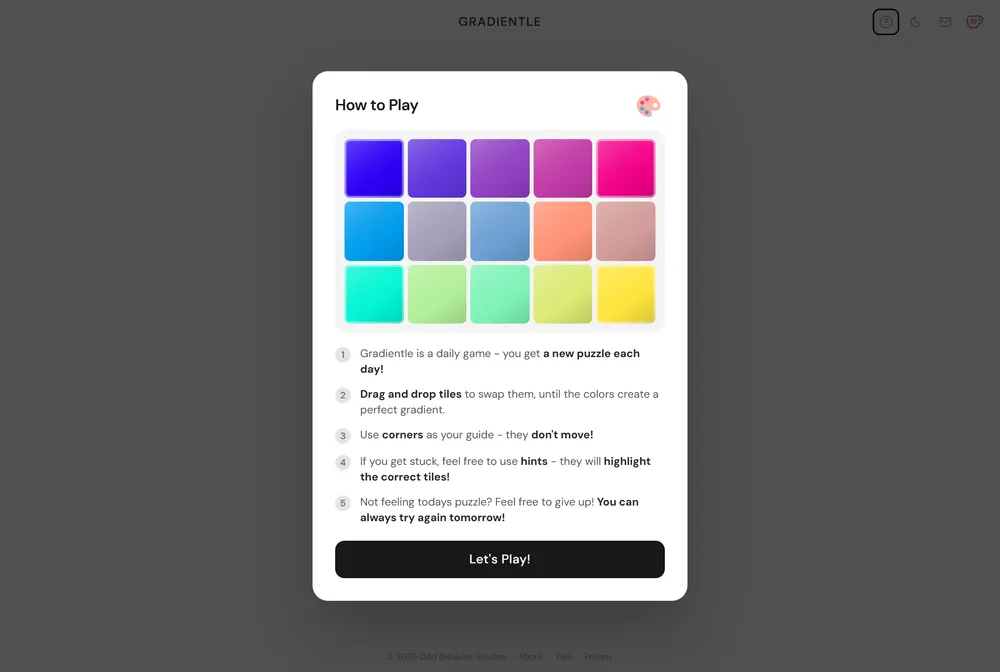
Gradientle is a free daily puzzle about color rather than words. Each day you get a grid of scrambled color tiles and rearrange them until the whole grid blends into one smooth gradient. The four corner tiles are locked in place and act as your guide, showing where the gradient starts and ends.
What is Gradientle?
The core loop is simple to grasp and harder to master. Everyone gets the same puzzle each day: a grid whose interior tiles have been shuffled out of order. The four corner tiles stay locked in place, and they show where the gradient begins and ends across both the horizontal and vertical color transitions. Your job is to drag and swap the interior tiles until every tile sits in its correct spot and the colors flow smoothly from corner to corner. There is no typing and no guess counter. As the site puts it, you drag and drop tiles to swap them until the colors create a perfect gradient.
What sets Gradientle apart from most games ending in -dle is that it is a visual perception puzzle, not a word or trivia guessing game. Instead of typing a guess and reading color-coded feedback, you physically move tiles around the board. The colors are generated in OKLAB, a perceptual color space developed by Björn Ottosson. As the About page explains, in OKLAB equal numerical steps look equal to human eyes. That keeps the finished gradient looking evenly graded rather than bunching up in the parts of the spectrum our eyes are more sensitive to, the way plain RGB steps often do.
Scoring is built around efficiency rather than luck. The site says your score is based on how many moves you make compared to the theoretical minimum number of moves needed to solve the puzzle from its scrambled state. The results screen reports your Moves Made, the Moves Needed, how far you finished Over par, and your Time. Optional hints highlight tiles that are already in the correct position, and each hint used costs 0.1 rating points. If you get stuck, you can give up at any time and try again the next day.
The site presents itself as the work of Odd Behavior Studios, named in the footer and on the About page, with a 2026 copyright. It keeps running statistics for you, including games played, win percentage, streak, and best, and there is a share button for posting your result. A dark-mode toggle is available. There is one puzzle per day, everyone gets the same one, it resets at midnight, your progress is saved locally, and a countdown timer shows when the next one arrives.
How to play Gradientle
- Open Gradientle at gradientle.pages.dev in your browser.
- Study the four fixed corner tiles, since they show where the gradient starts and ends and the direction the colors should flow.
- Drag and drop the scrambled interior tiles to swap them, moving each color toward where it belongs.
- Work outward from the corners, lining up the edge rows first so the interior falls into place.
- Use a hint sparingly if you are stuck, remembering it only highlights tiles already placed correctly and costs 0.1 rating points.
- Finish when every tile blends smoothly corner to corner, then check your Moves Made against the Moves Needed, your Over par, and your Time, and share your result.
Tips and strategy
- Solve the edges first. The site advises working the edges before the center, since edge tiles are constrained on two sides and are easier to place than the interior.
- Start with the corners as your ground truth. The four locked corners give you the whole gradient's roadmap, and everything in the interior is a smooth blend between them.
- Since scoring compares your moves against the theoretical minimum, plan swaps that place two tiles correctly at once rather than shuffling one tile repeatedly.
- Compare neighboring tiles for small jumps in brightness or hue. A tile that looks slightly out of step usually needs to trade places with an adjacent one.
- Save hints for late in the solve. Because they only highlight tiles already in the right spot, they are most useful for confirming your remaining trouble area, and each one costs 0.1 rating points.
- If a puzzle feels hopeless, remember you can give up at any time and try again the next day, so it is fine to experiment before committing.
Good to know
- Category
- Color puzzle
- Resets
- Daily at midnight, with a countdown to the next puzzle
- Cost
- Free
- Guesses
- No guess limit; scored on moves versus the minimum needed (Over par)
- Modes
- Single daily puzzle, with a dark-mode toggle
- Feedback
- Moves Made, Moves Needed, Over par, and Time; tracks played, win percentage, streak, and best
- Creator
- Odd Behavior Studios (per the site)
- Platform
- Browser (web)
Gradientle FAQ
Is Gradientle free?
Yes. The About page describes it as a free daily color puzzle game, and it plays in your browser with no purchase required.
How do you play Gradientle?
You are given a grid of scrambled color tiles with the four corners locked in place. You drag and drop the interior tiles to swap them until the colors blend into one smooth gradient from corner to corner. There is no typing and no guess limit.
When does Gradientle reset?
There is one puzzle per day, and it resets at midnight. Everyone gets the same puzzle, your progress is saved locally, and a countdown timer on the site shows when the next one arrives. No archive of past puzzles was found on the site.
Is Gradientle like Wordle?
Only in that it is a daily puzzle everyone plays the same version of. Instead of guessing words, you rearrange color tiles into a gradient, there is no guess limit, and you are scored on how few moves you use rather than color-coded letter clues.
Who made Gradientle?
The site credits Odd Behavior Studios, named in the footer and on the About page, with a 2026 copyright. Details about the studio beyond the site could not be independently confirmed.