Doctordle
Diagnose the daily clinical case.
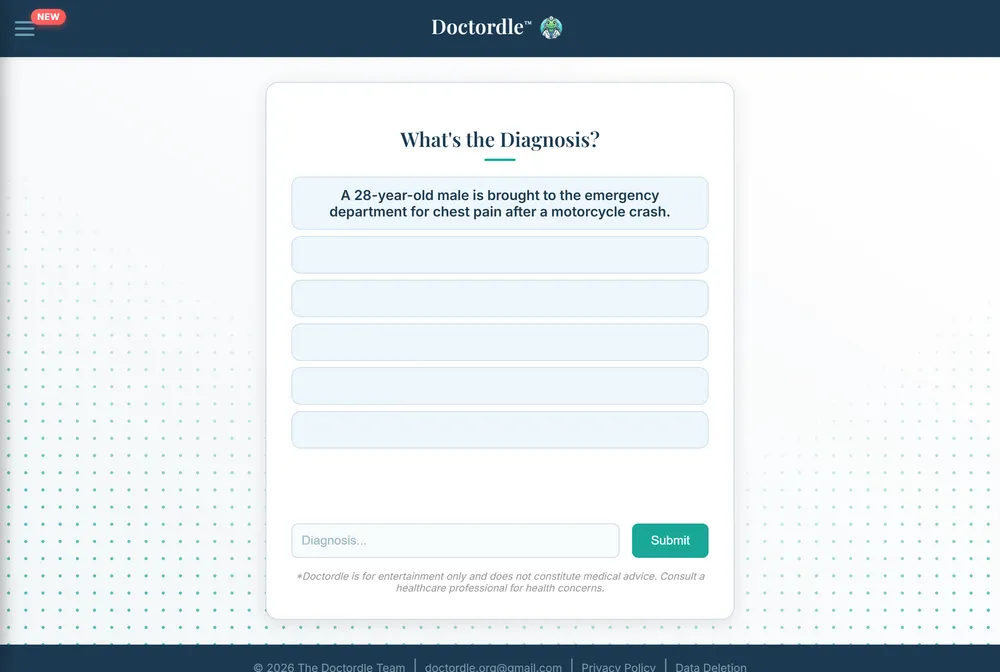
Doctordle turns one clinical case a day into a guessing game: you read a patient's opening presentation and try to name the diagnosis before the full picture unfolds. Every wrong guess reveals another clue, so each turn you choose between committing on an early read and waiting for one more detail. It is the same case for everyone, with an endless mode and an archive of past cases when you want more.
What is Doctordle?
Doctordle is a daily diagnosis puzzle that hands you the opening line of a clinical case and asks you to name the condition. A typical day might begin with something like a 53-year-old woman in the emergency department with new dizziness and one-sided hearing loss, or a 60-year-old with rapidly progressive dementia and behavioral changes. From that single thread you start guessing diagnoses. The case stays sealed until you commit, and every miss pries it open a little more. It is one shared case per day, the same patient for every player, with an endless mode waiting once you have solved the daily round.
What separates Doctordle from the broader field of Wordle spin-offs is that you are not matching letters, you are reasoning through a differential. There is no five-letter grid and no color-coded tiles for spelling. Instead, each wrong guess unlocks the next clue from the case notes, so the patient's history, exam findings, and labs arrive in stages rather than all at once. That structure rewards clinical pattern recognition over vocabulary, and it makes the same case feel different depending on how early you are willing to commit. You are essentially racing the reveal, trying to lock in the answer while the picture is still incomplete.
The game is published by a group identifying itself as The Doctordle Team, reachable at [email protected], and its archive of numbered cases begins with case #1 on July 17, 2025, marking the launch. The medical leaning is deliberate. Finished cases offer a short diagnosis summary assembled from publicly available medical literature with AI assistance, and you can copy an Anki-ready tag for spaced repetition, including labels aligned to USMLE Step 1 and Step 2. That makes it as much a study aid for medical students and trainees as it is a casual puzzle, though the clue-by-clue format keeps it approachable for anyone curious about how a diagnosis comes together.
Feedback is immediate and visual. You get up to six guesses, each wrong answer surfaces another detail, and finishing in fewer guesses is the natural goal. When you finish, Doctordle produces a Wordle-style shareable grid so you can post how many tries the case took without spoiling the diagnosis for others. Your win rate, current streak, and average guesses are stored locally in your browser, and an optional free account lets you carry those stats across devices. The vibe is calm and studious rather than flashy. People with medical training will often recognize a case in a guess or two, while everyone else can lean on the common conditions that show up frequently and still finish a round.
How to play Doctordle
- Open the day's case and read the opening patient presentation, which gives you a short scenario and a few starting details.
- Type a diagnosis into the guess field and submit it as your first answer.
- If the guess is wrong, Doctordle reveals the next clue from the case notes, adding history, exam findings, or labs.
- Weigh each new detail and decide whether to commit to a diagnosis now or wait one more turn for a sharper clue.
- Keep guessing, using up to six attempts, until you name the correct diagnosis or run out of tries.
- After the case closes, read the diagnosis summary, copy the Anki tag if you are studying, and share your result grid.
Tips and strategy
- Form a differential from the very first line before you guess, then let each revealed clue confirm or rule out candidates rather than starting fresh each turn.
- When the opening presentation is a textbook fit for one condition, guess it immediately, since finishing in fewer guesses is the natural goal.
- If two diagnoses look close, spend a guess to wait for the next clue, because one added lab value or exam finding usually separates them.
- Watch the patient demographics in the first line, because age, sex, and setting often steer the case toward the classic presentation of a condition.
- Default to common conditions before reaching for rare ones, as everyday diagnoses appear far more often than zebras.
- Use Endless mode to drill the patterns you keep missing, then bring that recognition back to the daily case.
Good to know
- Resets
- Daily, one new case per day
- Cost
- Free, no sign-up required to play
- Guesses
- Up to 6 per case
- Archive
- Yes, past numbered cases are playable
- Launched
- July 17, 2025 (case #1)
- Modes
- Daily case plus Endless mode
- Publisher
- The Doctordle Team
- Platform
- Browser, with optional free account for cross-device stats
Doctordle FAQ
Is Doctordle free?
Yes. You can play the daily case and the archive in your browser at no cost, and no sign-up is required. An optional free account lets you sync your stats and streak across devices.
How many guesses do you get in Doctordle?
You get up to six guesses per case. Each wrong answer reveals one more clue from the case notes, so the patient picture fills in as you go, and finishing in fewer guesses is the natural goal.
Is there a Doctordle archive?
Yes. Doctordle keeps an archive of past numbered cases that you can still play, starting from case #1 on July 17, 2025, so you can work through earlier puzzles you missed in addition to the current daily case.
Is Doctordle related to Wordle?
It borrows Wordle's one-shared-puzzle-a-day format and its shareable result grid, but the gameplay is different. You guess medical diagnoses from a clinical case rather than matching letters, so it tests clinical reasoning instead of spelling.
Who is Doctordle for?
Anyone can play, but it leans toward medical students and trainees. Finished cases include a literature-based diagnosis summary and an Anki export with USMLE Step 1 and Step 2 tags for spaced-repetition study.