Cemantle
Find the secret word by semantic warmth.
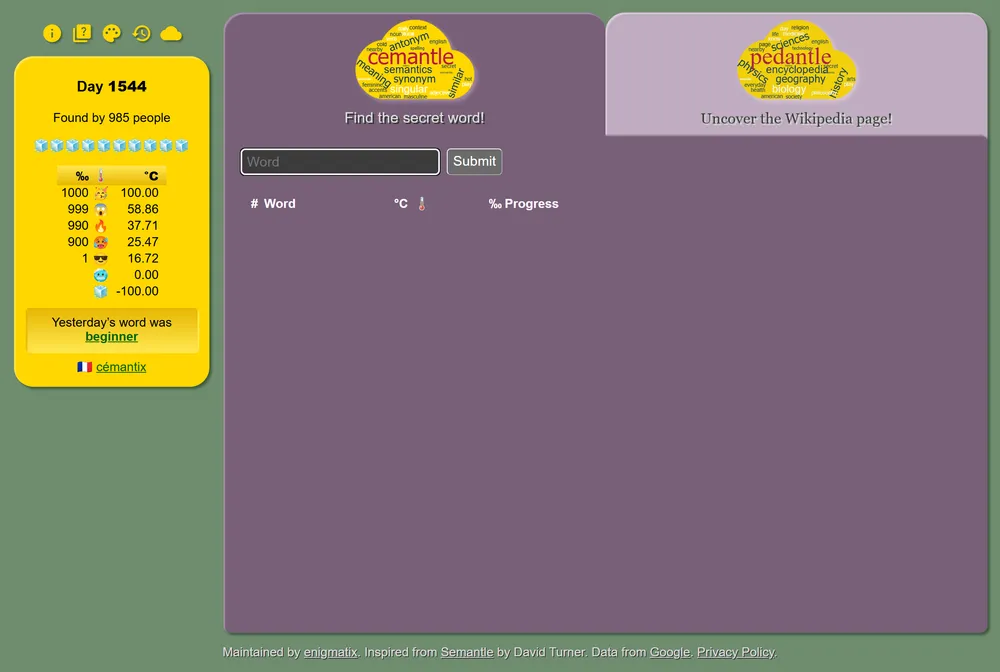
Cemantle hides one secret word each day and grades your guesses by meaning, not letters. Every word you submit returns a temperature score showing how semantically close it is to the answer, turning the puzzle into a warmer-and-colder hunt through related ideas. It is the English counterpart to the French game Cemantix, built on the same word-association model that powers Semantle.
What is Cemantle?
Cemantle is a once-a-day word game where the goal is to uncover a single hidden word using meaning instead of spelling. You type any word and the game returns a temperature reading that reflects how semantically close your guess sits to the secret answer, with hotter scores meaning the two words tend to appear in similar contexts. Because the comparison is built on a word-association model rather than shared letters, a guess can be burning hot while looking nothing like the target on the page. One word is locked in per day for every player worldwide, so the puzzle is the same for everyone until it resets.
What separates Cemantle from Wordle-style games is the absence of a fixed letter grid and the absence of a guess limit. There are no green or yellow tiles and no five-letter constraint: the answer can be any common English word, and you can submit as many guesses as it takes. Instead of narrowing down letters, you are navigating a map of concepts, watching which directions warm up and which go cold. That makes each session feel less like decoding and more like tracking an idea through its neighbors, which is why the game tends to reward broad vocabulary and lateral thinking over spelling tricks.
The game runs on a word-embedding model, and the site credits its data to Google's word2vec project, the same Word2Vec family of vectors popularized by Semantle, the original English semantic guessing game made by David Turner in early 2022 during the Wordle boom. Semantle's documented dataset is the word2vec model trained on Google News text, and Cemantle is widely understood to inherit that same lineage, though the Cemantle page itself only names Google as the source. Cemantle is the English-language member of the certitudes.org family alongside the French game Cemantix, and the site lists the project as maintained by a developer credited as enigmatix. Some secondary sources attribute the English Cemantle specifically to a developer named Julie while crediting enigmatix with the French original, so the exact authorship of the English version is not settled. Versions exist in several languages, so French, English, and other communities each chase their own daily secret word using the same underlying mechanic. The scoring reflects cosine similarity between word vectors, which is why related professions, objects, or themes cluster together in the results.
Feedback comes in two layers. Every guess gets a temperature score, and a list of your tries stays sorted so you can always see your warmest words at the top. When a guess lands among the model's 1000 closest associations, a proximity rank shown in per-mille (its position out of those 1000 nearest words) appears, telling you how near you are within that tight inner circle. On that scale the rank climbs toward the answer rather than falling: 1000 is the secret word itself, 999 is its single closest neighbor, and a guess with no rank at all is still outside the inner circle and effectively cold. When you finish, the game offers a shareable summary so you can compare your run with friends without spoiling the word. The difficulty leans hard, sometimes frustratingly so, but the slow warmer-and-colder climb is what fans of deeper daily puzzles come back for.
How to play Cemantle
- Type any English word into the guess box and submit it.
- Read the temperature score that comes back, where a higher number means your word is closer in meaning to the secret word.
- Use the sorted list of your past guesses to see which words ran warmest and build from those.
- Follow the heat by trying synonyms, related concepts, and words from the same topic as your warmest guesses.
- Watch for the proximity rank (shown per 1000) that appears when you get very close, where the rank climbs toward 1000 as you near the answer and 1000 is the secret word itself.
- Keep refining your guesses until you land on the exact secret word, then share your result and return for a new word the next day.
Tips and strategy
- Chase meaning, not spelling: a word that shares no letters with the answer can still score very warm, so do not waste guesses on small spelling variations.
- Open with broad, common nouns from several different domains (nature, work, emotions, technology) to find out which direction the answer leans before committing.
- When a guess runs hot, branch into its associations and contexts rather than its near-synonyms alone, since the model groups words that appear together, not just words that mean the same thing.
- Pay attention to the proximity rank, not just temperature: once a per-mille rank appears you are inside the inner circle, and pushing that rank up toward 1000 matters more than big topic jumps.
- Try different parts of speech of a warm idea, since the noun, verb, and adjective forms of a concept can score quite differently.
- Because there is no guess limit and no penalty, probe aggressively early and treat cold guesses as useful information about where the answer is not.
Good to know
- Resets
- Once daily on US time
- Cost
- Free to play
- Guesses
- Unlimited, no penalty
- Scoring
- Temperature plus a proximity rank toward 1000 (the answer)
- Model
- Word2Vec word embeddings; site credits data from Google
- Maintained by
- enigmatix (certitudes.org); English counterpart to Cemantix
Cemantle FAQ
Is Cemantle free?
Yes. Cemantle is free to play in the browser at cemantle.certitudes.org with no account or payment required.
How many guesses do you get in Cemantle?
There is no guess limit. You can submit as many words as you need, and there is no penalty for cold or wrong guesses, so the only goal is reaching the secret word.
When does Cemantle reset?
A new secret word appears once per day on US time, and the same word is shared by every player worldwide until the next reset. The Cemantle page itself does not list a specific timezone, so the exact local switchover can vary.
Is Cemantle related to Wordle or Semantle?
It is not a Wordle clone: there is no letter grid or five-letter limit. It is a semantic guessing game in the family of Semantle, the English game made by David Turner in 2022, and it is the English counterpart to the French game Cemantix.
How does the temperature score work in Cemantle?
Each guess is compared to the secret word using a word-embedding model, and the temperature reflects how close the two words are in meaning. Higher temperatures mean a closer association, and when you get very near, a proximity rank out of the 1000 nearest words appears. That rank rises toward the answer, so 1000 is the secret word itself and 999 is its closest neighbor.