Capitalibrate
Estimate the distance between two capitals.
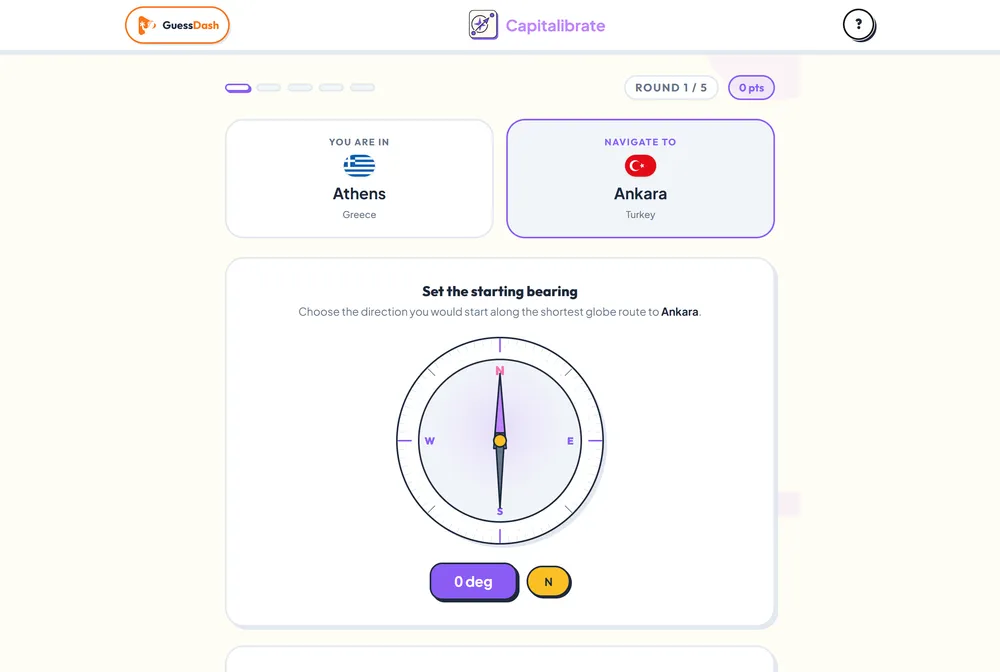
Capitalibrate is a daily geography game where you read the globe like a navigator instead of spelling out a word. Each day you are handed pairs of world capitals, and for every pair you spin a compass to point the way you would start traveling and estimate how many kilometers separate the two cities along the shortest route around the planet. It rewards a feel for direction and scale rather than rote memorization of country shapes or flags.
What is Capitalibrate?
Capitalibrate, hosted on the GuessDash daily-puzzle site, runs as a short set of rounds, often around five per day. In each round you see a starting capital and a destination capital, for example beginning in Seoul, South Korea and aiming for Vientiane, Laos. Your job is two-part: choose the heading you would set off on to follow the shortest path between them, and key in a distance estimate in kilometers. The interface gives you a working range, reported in secondary listings as roughly 100 km up to about 20,000 km, which keeps your guesses anchored to plausible real-world spans rather than wild numbers. That upper bound lines up neatly with geography, since the farthest two points on Earth sit about 20,037 km apart along a great circle.
What sets Capitalibrate apart from most Wordle-style games is that there is no hidden word and no row of colored letter tiles. The puzzle is spatial and numeric. You are reasoning about great-circle paths, the curved shortest routes that real long-haul flights follow, and that makes the game feel closer to navigation or piloting than to a vocabulary test. The compass mechanic also means two separate skills are tested at once: your sense of which way a city actually lies relative to another, and your sense of how far apart they truly are. A confident bearing paired with a sloppy distance, or vice versa, still leaves accuracy on the table.
Capitalibrate is published as part of GuessDash, a portal that groups daily challenges across geography, history, architecture, business, finance, and demographics. A specific individual creator is not publicly credited on the listing, so it is most accurate to describe it as a GuessDash title rather than to attribute it to a named person. Each round is scored on how close both your direction and your distance land relative to the real route. Daily games of this kind generally combine those round results into one figure you can compare and share, and Capitalibrate appears to follow that pattern, though the exact scoring display was not directly observable.
Because the answers are estimates that earn partial credit, you are rarely fully wrong, just more or less precise, which keeps the game approachable while still giving map enthusiasts plenty to chase. It suits people who like geography trivia, aviation and travel buffs who already think in flight paths, and anyone who enjoys a quick daily brain stretch. The difficulty scales naturally with the pairs: neighboring capitals are forgiving, while cross-hemisphere matchups expose how much the globe bends your intuition, since a route between far-flung cities can start off in a direction a flat map would never suggest.
How to play Capitalibrate
- Open the day's puzzle on GuessDash and read the first round's starting capital and destination capital.
- Picture the shortest route between the two cities as it would curve across a globe, not a flat map.
- Aim the compass in the direction you would set out from the starting capital to follow that route.
- Enter your distance estimate in kilometers, keeping within the range the game offers (reported as roughly 100 km up to about 20,000 km).
- Submit the round to see how close your bearing and distance were and bank the accuracy you earned.
- Repeat through all of the day's rounds, then check your combined result and share it.
Tips and strategy
- Settle the direction before the number: a badly wrong heading usually costs more than a moderate distance miss, so lock in the bearing you are confident about first.
- Think in great circles, since long routes between far-apart capitals bend toward the poles, which can shift your starting direction surprisingly far north or south.
- Build a few mental yardsticks, like the rough span between two capitals you know well, and scale other guesses up or down from those anchors.
- Use latitude and longitude clues from the city names: capitals on similar latitudes lean east-west, while big north-south jumps push your bearing toward true north or south.
- For trans-Pacific or trans-polar pairs, double-check that the shorter way might run the opposite direction from what a flat map suggests, since the globe can make west feel like east.
- Spread your effort evenly across the rounds, because one carefully reasoned round will not rescue several rushed ones when the results are combined.
Good to know
- Category
- Geography
- Publisher
- GuessDash (guessdash.com)
- Format
- Multiple rounds per day, often around five
- Guess type
- Direction (compass bearing) plus distance in kilometers
- Distance range
- Reported as roughly 100 km to 20,000 km
- Cost
- Free to play in a browser
Capitalibrate FAQ
Is Capitalibrate free?
Yes. Capitalibrate is free to play in your web browser on GuessDash at guessdash.com/capitalibrate, with no purchase or account required to take on the daily puzzle.
How does Capitalibrate work?
Each round gives you a starting capital and a destination capital. You aim a compass in the direction you would travel along the shortest globe route, then estimate the distance between them in kilometers. You score on how close both your direction and distance are.
How many rounds does Capitalibrate have?
Capitalibrate is played as a short set of rounds per day, often around five, with your results from each round contributing to your overall showing for the day.
Is Capitalibrate related to Wordle?
It shares the once-a-day, share-your-result spirit of Wordle, but the mechanic is completely different. There is no hidden word or letter grid; you estimate direction and distance between world capitals instead.
Does Capitalibrate use a compass and distance instead of a map?
Yes. Rather than placing a pin on a map, you set a compass bearing for the way you would head and type a kilometer estimate, so the game tests both your sense of direction and your sense of scale across the globe.