Box Office Game
Name the top five films of a past box-office weekend.
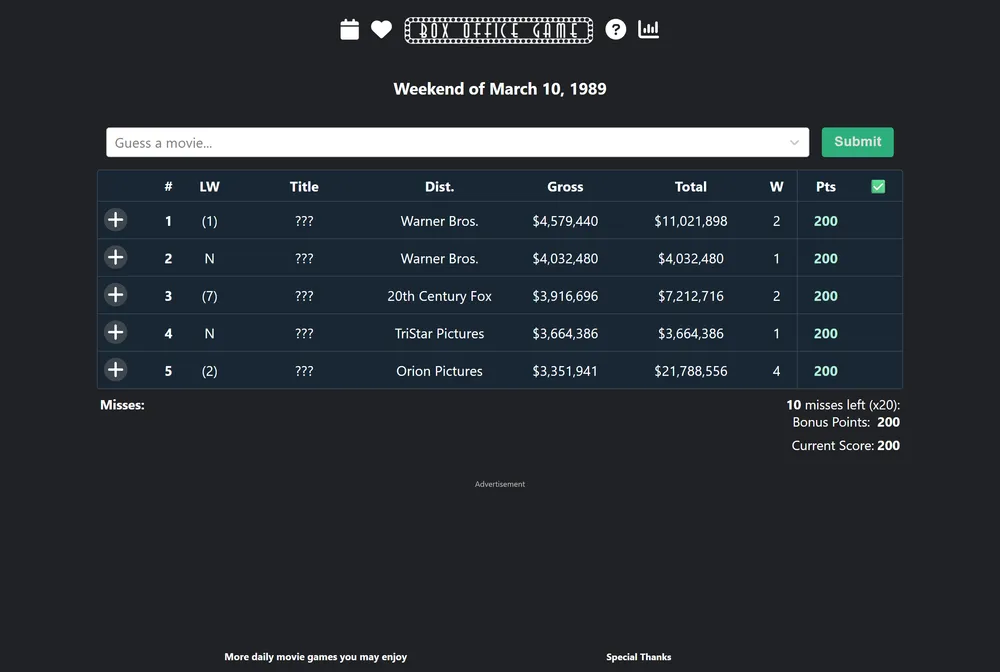
Box Office Game hands you a mystery weekend from box office history and challenges you to name the five films that topped the United States chart that weekend, ranked one through five. You guess film titles and manage a pool of points you can spend on weighted hints, so the real skill is deciding when to trust your memory and when to pay for help. It is a daily puzzle built for film buffs, born from a recurring segment on the Blank Check podcast.
What is Box Office Game?
Box Office Game is a daily browser puzzle about cinema history rather than spelling. Each day it selects one real weekend from the record of United States box office charts and asks you to reconstruct the top five films of that weekend in their exact finishing order, from the number one earner down to fifth place. Everyone who visits gets the same weekend on the same day, which is what gives the game its shared, comparable feel.
You begin with very little to go on: typically the distributor behind each slot and a running gross figure, plus whatever you can infer from the era those clues suggest. You fill all five ranked positions across a limited number of guesses. The twist that separates it from a plain trivia quiz is the economy layered on top. Each film slot is worth 200 points, and you can trade those points for hints whenever a row stumps you. Available reveals include the tagline, the director, an actor, the genre, the budget, the plot, and the final worldwide gross. Hints are weighted, so a broad clue like genre costs only a little while a heavily revealing clue like a plot summary costs much more, which makes every reveal a real decision rather than a free lookup.
The game traces back to a recurring segment on Blank Check with Griffin and David, the movie podcast hosted by actor Griffin Newman and critic David Sims. The original game grew out of a habit Newman had as a kid of reviewing past box office numbers with his father, Peter Newman, and a daily web version later appeared at boxofficega.me. The site credits the Blank Check podcast for the idea and pulls its data from The Numbers for box office figures and TMDb for film details. That pedigree shows in the tone: it rewards genuine film knowledge and a feel for what was filling theaters in a given decade, not just luck.
When you finish, the result works much like Wordle's shareable grid. Instead of green and yellow tiles for letters, your summary shows which of the five films you nailed outright and which ones you had to buy hints to crack, alongside your remaining score. That makes results easy to compare with friends who solved the same weekend. The overall vibe is friendly but genuinely tough, especially for mid-chart titles from decades you did not live through, which is why it has a steady following among film buffs, podcast listeners, and anyone who likes testing how deep their movie memory really goes.
How to play Box Office Game
- Open the day's puzzle and study the starter clues for each of the five ranked slots, usually the distributor and a gross figure that hint at the weekend's era.
- Type a movie title to guess which film holds one of the top five positions for that weekend.
- Correct guesses lock into their ranked slot; incorrect ones draw down your limited supply of guesses.
- When a slot resists you, spend points on a weighted hint such as genre, director, an actor, tagline, budget, plot, or final worldwide gross.
- Keep filling slots, balancing your remaining guesses against your point total, until all five films are placed in order.
- Finish the puzzle, then share the Wordle-style result grid showing which films you knew cold and which needed hints.
Tips and strategy
- Combine the distributor with the running gross to pin down the weekend's decade, then mentally scroll to what was dominating screens in that window.
- Buy the cheaper clues first: a broad reveal like genre costs far fewer points than a plot or actor reveal, so probe lightly before committing to an expensive hint.
- Lock in the obvious blockbuster at number one early, since knowing the headliner often jogs your memory for the films sitting just below it.
- Hold your points for the stubborn mid-chart slots, which are usually the hardest, rather than spending them on titles you would likely recall anyway.
- Watch your two budgets separately: running low on guesses is a different danger than running low on points, and the smart play shifts depending on which is scarcer.
- Use a confirmed slot as a dating anchor, because once one film's era is certain, the surrounding ranks must come from the same handful of weeks.
Good to know
- Resets
- Daily; everyone gets the same weekend each day
- Cost
- Free to play in a web browser
- Goal
- Place the top five films of a mystery weekend in order
- Scoring
- 200 points per film; hints have weighted point costs
- Origin
- Based on a segment from the Blank Check with Griffin and David podcast
- Data sources
- The Numbers for box office figures, TMDb for film details
Box Office Game FAQ
Is Box Office Game free?
Yes. It plays for free in any web browser at boxofficega.me, with no account required. The creator also runs a Ko-fi page where supporters can tip and unlock access to the game's archive of past puzzles.
How do you play Box Office Game?
Each day you are given a mystery weekend from box office history and must name the five films that topped the United States chart that weekend in their correct ranked order, guessing titles and spending points on hints when a slot stumps you.
How does scoring work in Box Office Game?
Each of the five film slots is worth 200 points. You spend those points on weighted hints, where revealing clues cost more than broad ones, so the goal is to solve the chart while keeping as many points as possible.
When does Box Office Game reset?
It is a daily puzzle, so a fresh weekend appears each day and every player worldwide gets the same one to solve.
Is Box Office Game related to Wordle?
It is not made by Wordle's team and is not a word game, but it borrows the daily-puzzle format and a shareable result grid that shows which films you knew and which needed hints. The game's idea comes from the Blank Check podcast.